ai-cloud
The VMware Alternative for GPU Workloads
Traditional VMs add a hypervisor tax that kills GPU performance. vCluster delivers bare metal speed with strong tenant isolation, no hypervisor required.
Traditional VMs add a hypervisor tax that kills GPU performance. vCluster delivers bare metal speed with strong tenant isolation, no hypervisor required.
Legacy hypervisor architecture creates three compounding problems for AI and GPU infrastructure teams.
Virtualization overhead degrades GPU throughput. Workloads that need bare metal speed cannot afford the latency VMware introduces.
Standard namespace partitioning exposes tenants to shared blast radius: platform internals, other tenants' nodes and pods remain visible.
Provisioning a full physical cluster per tenant is slow, costly, and operationally unsustainable at GPU cloud scale.
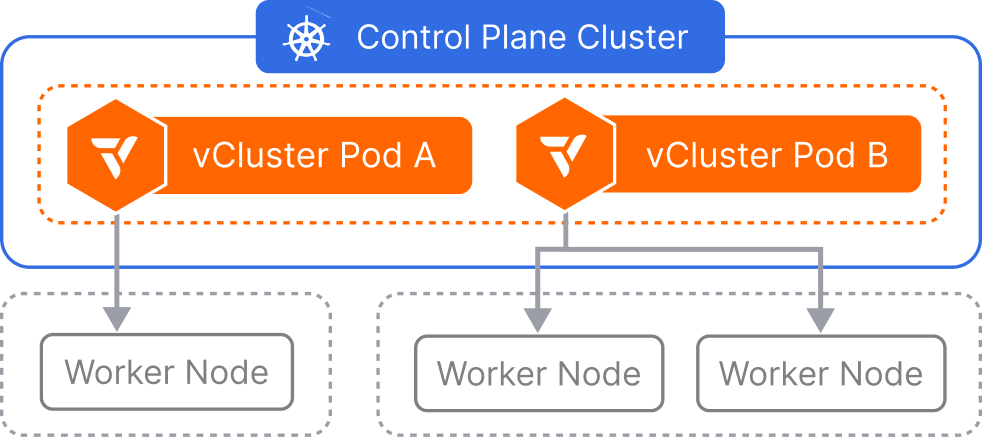
vCluster virtualizes the Kubernetes control plane itself, giving each tenant a real API server, etcd, and RBAC as a lightweight pod on bare metal. For production deployments, Private Nodes, dedicated worker nodes with per-tenant CNI and storage, deliver hardware-level isolation. No hypervisor, no VM overhead, no performance penalty. Production-proven across 100K+ GPUs, 50+ GPU clouds, and Fortune 500 customers.
From bare metal provisioning to workload-level isolation, vCluster covers the full stack modern GPU infrastructure demands.
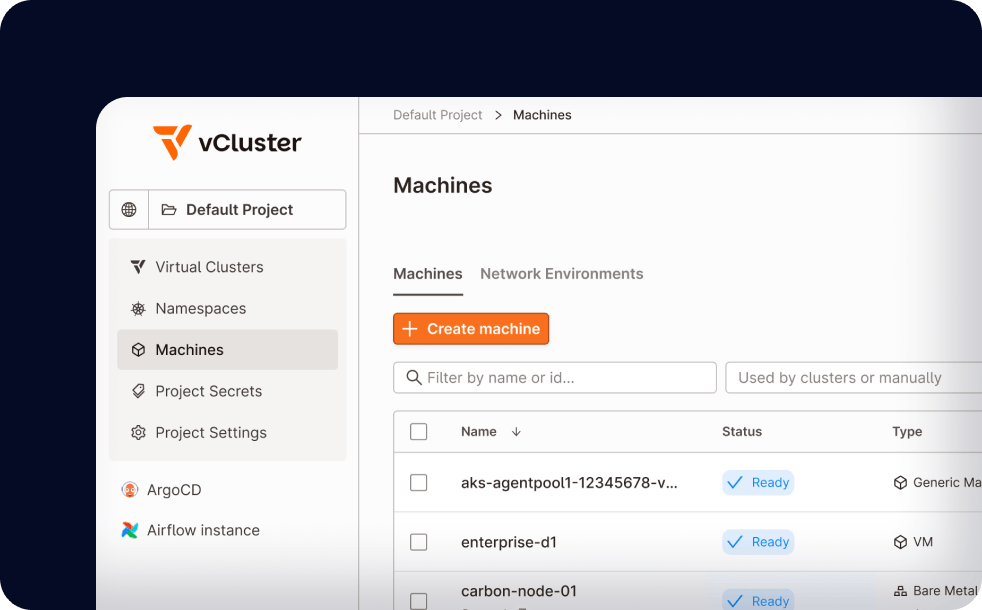
PXE boot, OS installation, machine registration, and network configuration handled automatically. Go from GPU rack to production-ready Kubernetes without manual steps or intermediate dependencies.
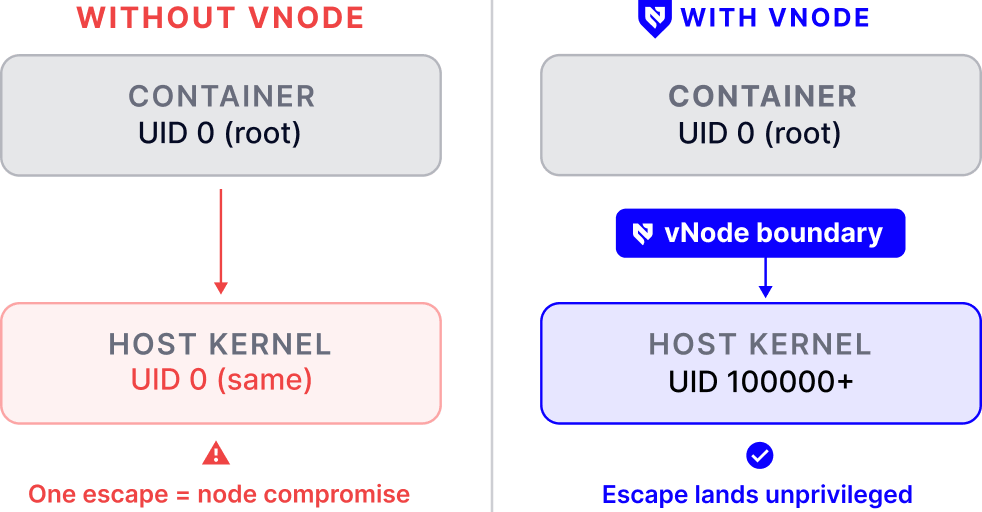
vNode secures each workload using seccomp, cgroups, namespaces, and AppArmor, preventing container breakouts and limiting blast radius while preserving near-bare-metal performance. No hypervisor tax, no VMware-style overhead.
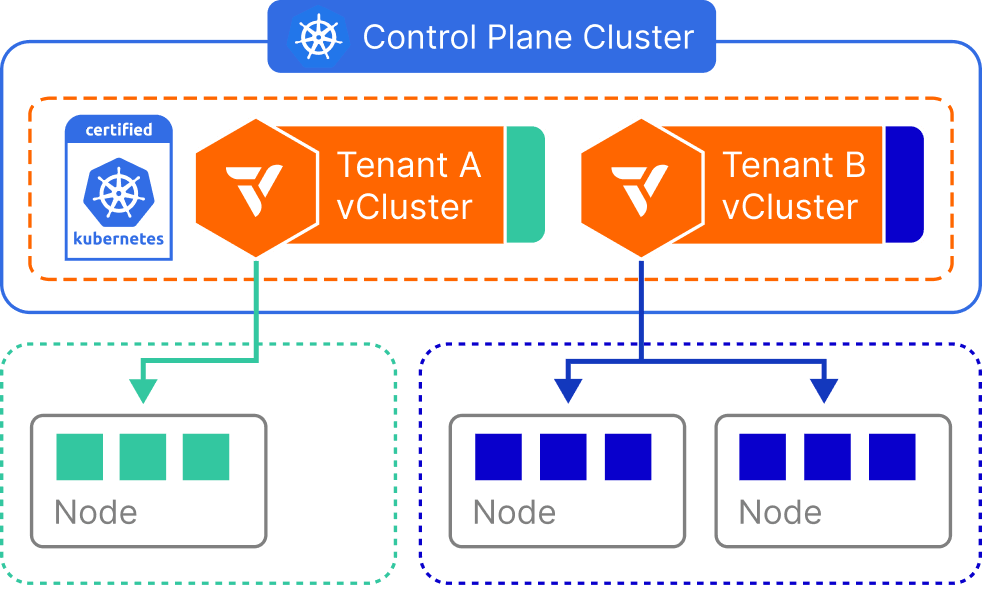
Each tenant gets physically dedicated GPU nodes with their own CNI and CSI. No workload bleed, no noisy-neighbor contention: the hardware isolation GPU workloads require.
Each tenant gets a fully isolated CNCF-certified Kubernetes control plane running as a lightweight pod: own API server, etcd, and scheduler. No physical cluster provisioning required.
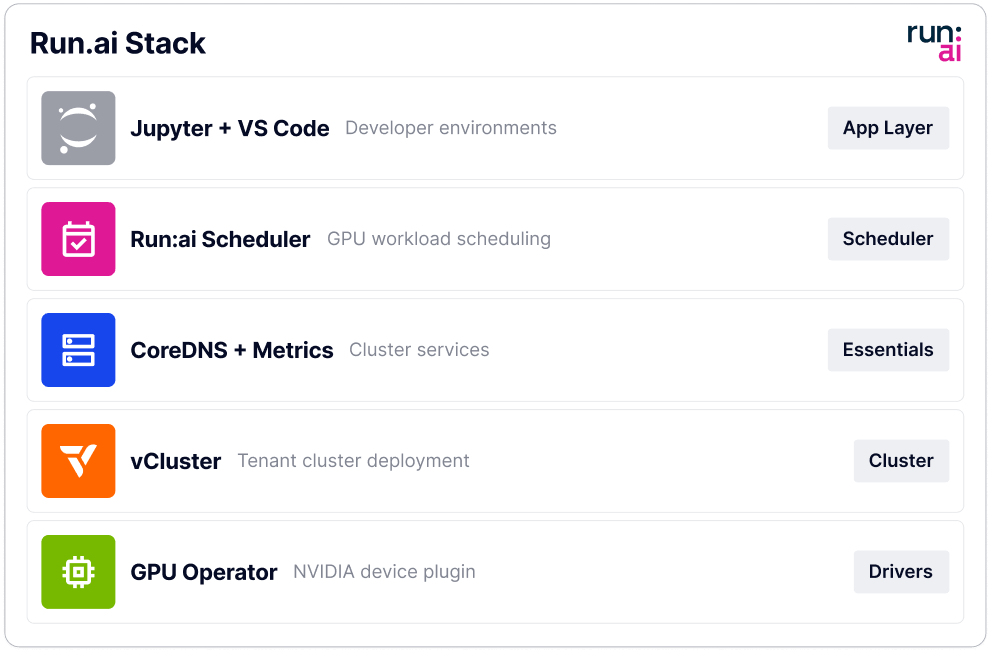
Turn a bare Kubernetes cluster into a production AI platform in minutes with pre-validated stacks for partner integrations like Run:AI, as well as Ray and Jupyter. Skip weeks of integration work for GPU workloads.
This isn’t a side project. Behind every vCluster deployment is 5+ years of deep K8s engineering, security hardening, and battle-tested infrastructure work at massive scale.
Talk to our team about your stack
Deploy vCluster on your infra in minutes
Go live with a hyperscaler-grade tenant experience in days
VMware introduces hypervisor overhead that degrades GPU performance, a critical liability for AI training and inference workloads that require bare metal throughput. vCluster eliminates that overhead by virtualizing the Kubernetes control plane rather than the hardware layer. Each tenant gets a fully isolated, CNCF-certified Kubernetes cluster running as a lightweight pod directly on bare metal GPU nodes. The result is strong tenant isolation without the VMware hypervisor tax.
Yes. vCluster Standalone runs as a binary directly on bare metal Linux with no external Kubernetes dependency, no k3s, kubeadm, or k0s required as a base layer. The vMetal component adds zero-touch provisioning for GPU servers, handling PXE boot, OS installation, machine registration, and network automation via Netris. The full path from GPU rack to isolated tenant clusters, with Private Nodes as the production default for hardware-level isolation, is covered without introducing any hypervisor layer.
vCluster combines three isolation layers. At the control plane level, each tenant gets a dedicated API server, etcd, RBAC, and CRDs running as isolated pods. At the node level, Private Nodes, the production default, give each tenant dedicated physical GPU nodes with their own CNI and CSI. At the workload level, vNode uses kernel-native mechanisms (seccomp, cgroups, namespaces, and AppArmor) to prevent container breakouts without any VM or hypervisor overhead.
vCluster powers 100K+ GPUs in production across 50+ GPU clouds and Fortune 500 customers. vCluster is named in the NVIDIA DGX SuperPOD reference architecture. Customers include CoreWeave and Nscale. Boost Run launched a managed Kubernetes offering in less than 45 days, and Lintasarta launched a GPU cloud in Indonesia in 90 days using vCluster.
Yes. vCluster's Certified Stacks provide pre-validated environments for partner integrations like Run:AI, as well as Ray and Jupyter. These stacks are tested and certified to work with vCluster tenant isolation, so AI platforms run in fully isolated tenant environments without custom integration work. A bare Kubernetes cluster can be turned into a production AI platform in minutes rather than weeks.
vCluster offers a flexible isolation spectrum across three levels. Private Nodes, the production default, give tenants fully dedicated physical GPU nodes with no cross-tenant workload exposure. For dev, test, and trusted-team workloads, Shared Nodes provide namespace and resource quota boundaries on shared physical hardware: the most cost-efficient model. Dedicated VMs combined with vNode add kernel-native workload isolation and container breakout protection. Teams can mix isolation tiers across their tenant fleet based on workload sensitivity and cost requirements.
See how vCluster delivers bare metal GPU performance with full tenant isolation.
