Hybrid Kubernetes Standardization

One Operating Layer Across Every Compute Source.

Standardize Kubernetes across public cloud, AI clouds, on-prem, edge, GPU, and CPU. Operations stay the same no matter where compute is supplied, and workloads shift between environments without re-architecting.

Trusted by the teams at
The Market Reality

Every Cloud and Data Center Ships a Different Kubernetes.

You need a unified operating layer, not a different Kubernetes stack for every cloud, every region, and every data center.

Every Compute Source Starts With Its Own Stack

EKS, GKE, AKS, OpenShift, vanilla on-prem, k3s at the edge. Each ships with its own tooling, upgrade path, and security boundary. Nothing transfers. Expertise stops at every fence.

Standardization Projects Stall Mid-Build

Most platform teams building a unified Kubernetes layer are still mid-project two years in. Scope expands faster than the team can ship.

Tenant Isolation Means More Control Planes (or Worse)

Share one control plane and tenants see platform internals. Dedicated cluster per tenant means a dedicated control plane for every one. Neither holds in production.

Don’t have the cycles to build a unified operating layer from scratch?

vCluster standardizes your entire estate under one operating model. Same playbook. Every environment. Every time.

HOW IT WORKS

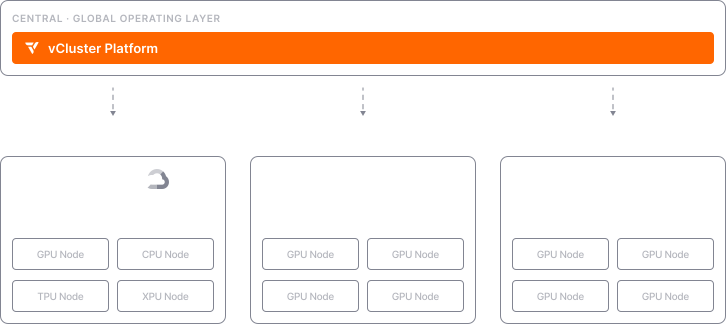
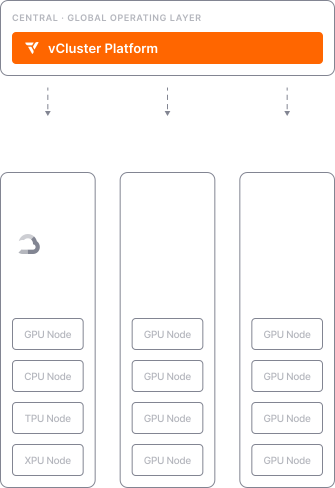
One Management Plane for Distributed Compute Aggregation.

One ops team. Every environment. Zero per-provider tooling.

  • One central control plane across your entire compute estate
  • Runs on top of managed Kubernetes (EKS, GKE, AKS) or directly on bare metal
  • Workloads shift freely between cloud, on-prem, edge, GPU, and CPU
Tenant Experience

Give Every Tenant a Hyperscaler Experience

Internal teams, customer-facing workloads, regulated business units. They get a clean Kubernetes environment. Your platform stays hidden, protected, and stable.

Standard Control Plane Nodes

Every tenant can see, touch, and break things they shouldn’t.

  • No isolation. Tenants see platform internals they shouldn’t, something hyperscalers abstract away from end users.
  • Security exposure. Control plane components can be compromised through tenant workloads.
  • Stability risk. Tenants can accidentally delete or modify platform components, causing downtime.
Virtual Control Plane (Run as Pods)

Every tenant sees only their own cluster. Your platform stays hidden, protected, and stable.

  • Clean experience. Tenants see only their own nodes and pods, just like in a hyperscaler.
  • No security exposure. Control plane and platform components are fully hidden from tenant workloads.
  • No stability risk. Platform infrastructure is protected from accidental changes or deletions by tenants.

Three Products. One Operating Layer. Production at Every Tier.

vCluster delivers the operating layer for hybrid Kubernetes: from the bare metal underneath, up through tenant-isolated workload environments, across every compute source. Each product works independently or as a unified platform.

Runtime-level workload isolation
One Kubernetes layer, every compute source
Operate bare metal like cloud

Runtime-level isolation for tenant workloads

Blocks container escapes at the node level

Each tenant workload runs in a dedicated kernel boundary. The compromise of one tenant doesn’t reach another, and it doesn’t reach the platform.

Container-native, no hypervisor tax

No micro-VM, no syscall interception. Bare metal GPU and CPU performance preserved. Works on bare metal, cloud, and any Kubernetes.

Drop-in alternative to gVisor and Kata Containers

Pairs naturally with vCluster tenant clusters for defense-in-depth. Hardens control plane pods and tenant workloads against compromise.

One Kubernetes layer, every compute source

Provision tenants across managed services and bare metal

One platform to manage tenants across EKS, GKE, AKS, and private cloud. Developers get the same experience regardless of infrastructure.

Tenant clusters for any tenant in production

Developer, team, customer, workload, machine, or service. Each tenant gets its own dedicated API server, etcd, and RBAC. The platform itself stays abstracted away.

Shift workloads freely across the estate

Workloads move between public and private cloud, between DCs, and between GPU and CPU tiers without re-architecting.

Operate bare metal like cloud

Zero-touch bare metal provisioning

PXE boot and OS configuration happen automatically. Declare bare metal nodes as Kubernetes resources. Hardware failures trigger automatic reprovisioning.

Full machine lifecycle, one platform

Provision, patch, repurpose, and decommission hardware from one platform. No more fragmented tooling across lifecycle stages.

Karpenter-compatible bare metal autoscaling

Bare metal nodes scale with workload demand, same model as your cloud fleet. The missing piece for bringing private capacity into the same operating model as public cloud.

Standardize, Don’t Fragment

What This Means for Your Business

One Operating Model Across the Estate

EKS, AKS, GKE, on-prem, edge, GPU racks: all managed through a single control plane with shared tooling. Your platform team’s work compounds instead of fragmenting.

Faster Time to a New Environment

After the first environment is onboarded, the playbook repeats. Standing up production Kubernetes in a new region or DC drops from months to hours.

A Consistent Developer Experience

Internal developers ship to the same Kubernetes interface whether the workload lands on EKS, GKE, AKS, on-prem, or edge. The platform team owns the surface area.

Decreased TCO

One ops team operates the entire fleet. No per-cloud specialists. No bespoke runbooks. Tooling investment compounds across every compute source instead of being rebuilt for each.

Shift Workloads Freely

Workloads move between public and private cloud, between DCs, and between GPU and CPU tiers without re-architecting. Repatriation and regional rebalancing stop being multi-quarter projects.

Tenant Isolation That Holds in Production

Every tenant gets verifiable isolation, without standing up a dedicated cluster for each one. The audit story is the same regardless of where the workload runs.

Built For

Where Hybrid Is Already the Reality

Distributed footprints. Regulated workloads. Already running hybrid Kubernetes, and looking to standardize it.

Financial Services

Multi-cloud across AWS, Azure, GCP. Owned DCs for trading and risk. Regional data residency on every workload.

Automotive

Factory floor edge. Manufacturing and R&D under different residency rules. Multi-cloud and on-prem across EU, US, and China.

Healthcare & Pharma

HIPAA, regional health data laws, clinical trial residency. R&D running AI on owned GPU capacity.

Public Sector

Sovereign cloud, non-negotiable. In-country residency on every workload. Production spanning classified networks, civilian cloud, and on-prem.

Ready to Standardize Your Kubernetes Estate?

Stop running five Kubernetes flavors in production. Get one operating layer across every compute source, with the tenant isolation and workload portability your estate already needs.