platform-eng

Virtual Control Plane Kubernetes for AI Clouds

Stop provisioning full clusters for every GPU tenant. vCluster virtualizes the Kubernetes control plane so tenant clusters spin up in seconds on shared bare metal, with full API server, etcd, and RBAC per tenant.

Trusted by the fastest-growing AI cloud providers
Problem

Why Traditional Kubernetes Falls Short

Scaling GPU tenants with standard Kubernetes forces painful tradeoffs between isolation, cost, and speed.

Namespace Isolation Is Too Weak

Tenants can see platform internals they should not: cluster-wide agents, other tenants' nodes and pods, shared blast radius.

Full Clusters Are Too Expensive

Provisioning separate physical clusters per tenant drives up costs, slows onboarding, and wastes GPU capacity at scale.

DIY Takes Too Long

Building a GPU cloud platform in-house requires significant engineering investment.

Solution

One Virtual Control Plane Per Tenant, at Scale

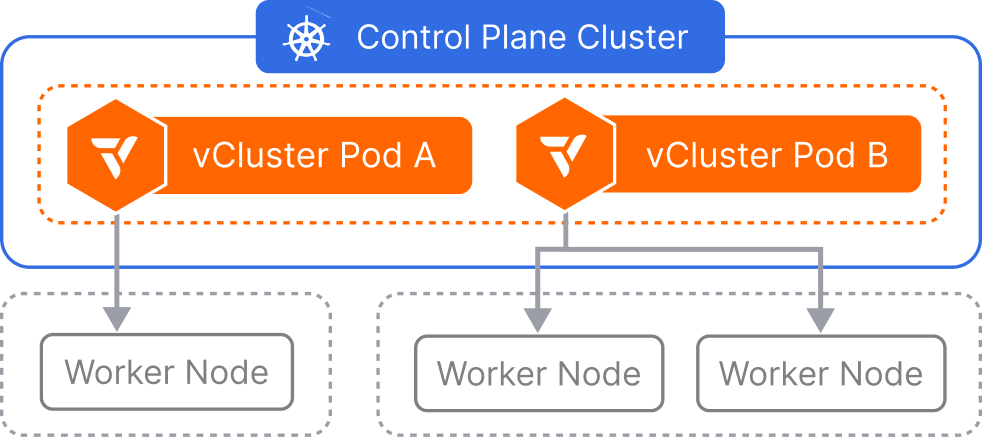
vCluster virtualizes the Kubernetes control plane itself, running CNCF-certified tenant clusters as lightweight pods inside a control plane cluster. Every tenant gets a real API server, etcd, scheduler, and full cluster-admin without a single additional physical machine. Production-proven across 100K+ GPU nodes and 50+ GPU clouds.

Built for GPU Clouds That Need Real Isolation

A virtual control plane for Kubernetes that spans every layer, from bare metal provisioning to tenant cluster orchestration to workload-level security.

Core Technology

Virtual Control Planes Per Tenant Cluster

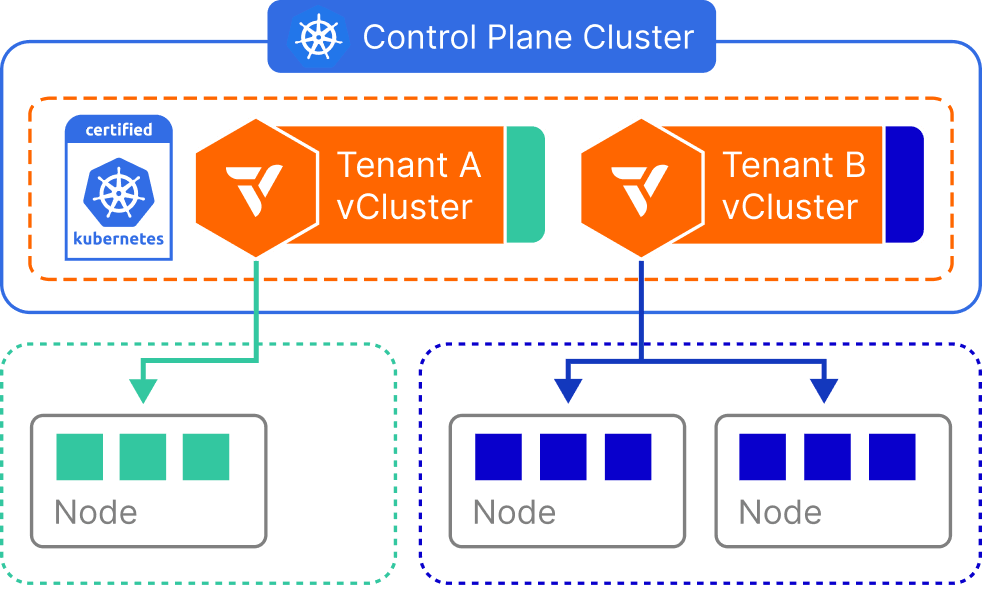
Each tenant gets a dedicated Kubernetes virtual control plane running as a pod (own API server, etcd, and scheduler) spinning up in seconds on shared GPU infrastructure with near-zero overhead.

  • Tenant clusters launch in seconds
  • Full API server and etcd per tenant
  • No additional physical machines required
Standards Compliance

CNCF-Certified K8s Per Tenant

Every tenant cluster is a fully conformant, CNCF-certified Kubernetes control plane: 100% API compatibility. Tenants run standard tooling, operators, and CRDs without hitting proprietary limitations.

  • 100% Kubernetes API compatibility
  • Standard tooling works out of the box
  • Named in the NVIDIA DGX SuperPOD reference architecture
Hardware Isolation

Dedicated Physical Nodes Per Tenant

Private Nodes, the production default, give each tenant fully dedicated physical GPU nodes with their own CNI and CSI. No shared compute, no noisy-neighbor risk: complete hardware separation within the virtual control plane model.

  • Dedicated GPU nodes per tenant
  • Own CNI and CSI per environment
  • Complete hardware separation per tenant
Workload Security

Kernel-Native Isolation Without VM Overhead

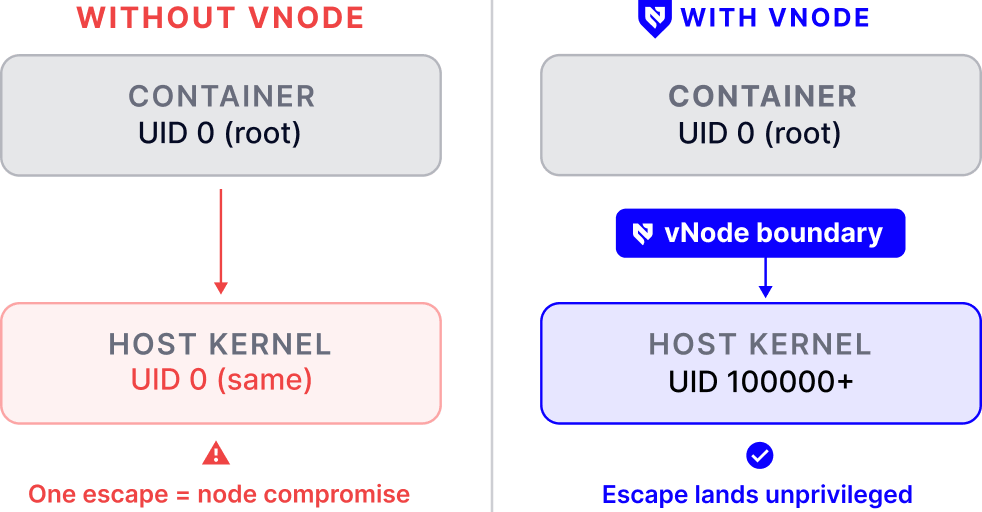
vNode adds kernel-native workload isolation using seccomp, cgroups, namespaces, and AppArmor, preventing container breakouts at bare metal GPU performance. Because no hypervisor layer is introduced, bare metal GPU performance is fully preserved for each workload.

  • Container breakout protection built in
  • No hypervisor overhead on GPU workloads
  • Pairs with control plane isolation layer
Platform Operations

Central Fleet Management Across Tenants

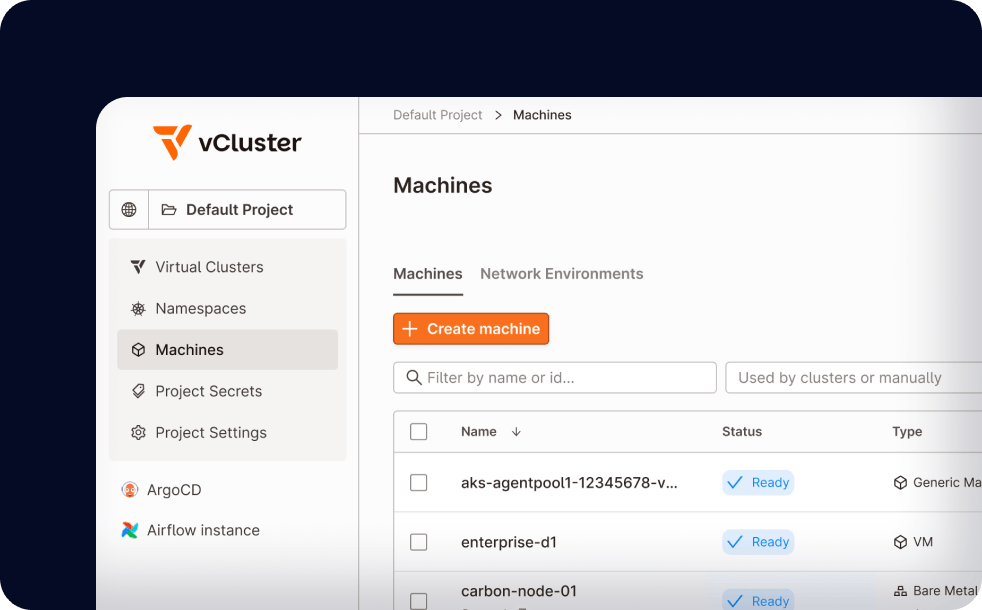
Manage all tenant clusters from a single control plane via UI, CLI, and API. SSO, quotas, templates, and auto-sleep are built in, so platform teams operate hundreds of tenant environments without custom tooling.

  • Single pane across all tenant clusters
  • SSO, quotas, and templates built in
  • Boost Run launched managed K8s in 45 days

Why vCluster

This isn’t a side project. Behind every vCluster deployment is 5+ years of deep K8s engineering, security hardening, and battle-tested infrastructure work at massive scale.

100K+
GPU Nodes Powered
50+
GPU Clouds & F500s
<45
Days to Launch
30K
GitHub Stars

Get Started in 3 Steps

1
Schedule a Demo

Talk to our team about your stack

2
Deploy vCluster

Deploy vCluster on your infra in minutes

3
Onboard Your Tenants

Go live with a hyperscaler-grade tenant experience in days

FAQs

What is a virtual control plane in Kubernetes?

A virtual control plane in Kubernetes is a fully isolated tenant K8s API server, etcd, and scheduler that runs as a lightweight process inside a control plane cluster: rather than on dedicated physical infrastructure. vCluster implements this model so each tenant gets a real Kubernetes control plane with full API compatibility, cluster-admin rights, and independent RBAC, without requiring separate physical machines. This is fundamentally different from namespace isolation, which shares a single control plane across all tenants.

How does a virtual control plane differ from namespace isolation?

Namespace isolation partitions resources within a single shared Kubernetes control plane. Tenants can still see cluster-wide agents, nodes, and platform internals they should not access. A virtual control plane gives each tenant their own API server and etcd entirely, so one tenant's activity cannot affect another's control plane state. For untrusted or production tenants in AI cloud environments, vCluster Platform's production default, Private Nodes, adds dedicated physical GPU nodes with per-tenant CNI and storage, delivering hardware-level isolation that approaches a dedicated physical cluster.

Can a virtual control plane run on bare metal GPU servers?

Yes. vCluster includes a standalone binary mode that runs a lightweight CNCF-certified control plane binary directly on bare metal, no k3s, kubeadm, or external Kubernetes dependency required. Tenant cluster control planes then run as pods inside that base layer. This approach powers more than 100K GPU nodes in production across 50+ GPU clouds, including GPU cloud providers that launched managed Kubernetes offerings in under 90 days.

How many tenant clusters can a single control plane cluster support?

For production workloads with untrusted tenants, Private Nodes are the production default: dedicated worker nodes with per-tenant CNI and storage. vCluster has created more than 40 million tenant clusters across its production deployments, with customers running hundreds of isolated tenant environments on shared GPU infrastructure. The virtual control plane model adds near-zero marginal overhead per tenant because control planes run as lightweight pods, not full physical clusters. Actual scale depends on control plane cluster capacity, workload profiles, and the isolation tier selected for each tenant.

Is vCluster's virtual control plane Kubernetes CNCF-certified?

Yes. Each tenant cluster created by vCluster is a CNCF-certified Kubernetes distribution with 100% API compatibility. Tenants can install custom CRDs, configure RBAC, and use any standard Kubernetes tooling or operator without hitting proprietary API limitations. vCluster is also named in the NVIDIA DGX SuperPOD reference architecture.

How long does it take to launch a managed Kubernetes service using vCluster?

Boost Run launched a managed Kubernetes offering in fewer than 45 days. Lintasarta built a GPU cloud in Indonesia in 90 days with hundreds of tenant clusters running on vCluster. These timelines reflect the virtual control plane approach: tenant clusters spin up in seconds, and the platform ships with fleet management, self-service portals, and Day 2 operations built in, eliminating months of custom development.

Launch Tenant Clusters in Seconds

See how a virtual control plane for Kubernetes scales your GPU cloud without physical cluster overhead.