platform-eng

The OpenShift Alternative for GPU Clouds

OpenShift was built to deliver applications to your own developers. Selling GPU capacity is a different business. vCluster gives every customer vanilla, CNCF-certified Kubernetes on your hardware, with Private Nodes as the production default for dedicated GPU nodes.

Trusted by the fastest-growing AI cloud providers
Problem

Why Application Platforms Struggle as GPU Products

In our analysis, the platform model assumes your tenants are colleagues. GPU clouds sell to strangers.

Every Layer Is OpenShift

Hosted control planes run on an OpenShift management cluster, and each hosted cluster is a full OpenShift cluster. Your customers inherit a platform when what they asked for was Kubernetes.

You Pay Per Node on Capacity You Resell

Subscriptions attach to the worker nodes you are trying to monetize. That puts a floor under every GPU hour before a customer runs anything.

A Product Surface You Never Sell

Integrated registry, Source-to-Image, pipelines, developer console. Application delivery machinery a GPU cloud carries and never charges for.

Solution

Sell Kubernetes, Not a Platform

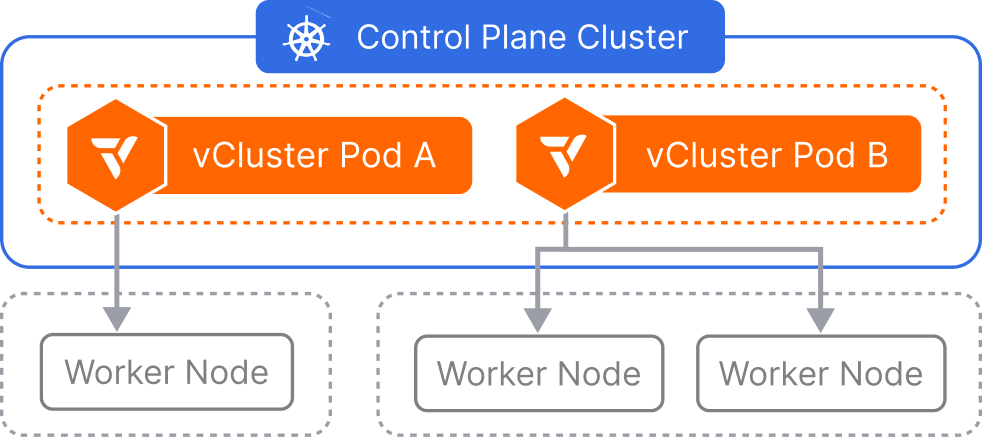
vCluster virtualizes the Kubernetes control plane, so every customer gets a real, CNCF-certified cluster with their own API server, etcd, and RBAC, running as a lightweight pod and ready in seconds. Private Nodes, the production default, assign dedicated GPU nodes with per-tenant CNI and storage over an encrypted WireGuard VPN. vMetal takes the stack down to the rack. Proven across 100K+ GPU nodes and 50+ GPU clouds.

Built for Selling GPU Capacity

What a GPU cloud needs from the layer underneath it, without the application delivery surface on top.

Tenant Isolation

A Real Cluster Per Customer in Seconds

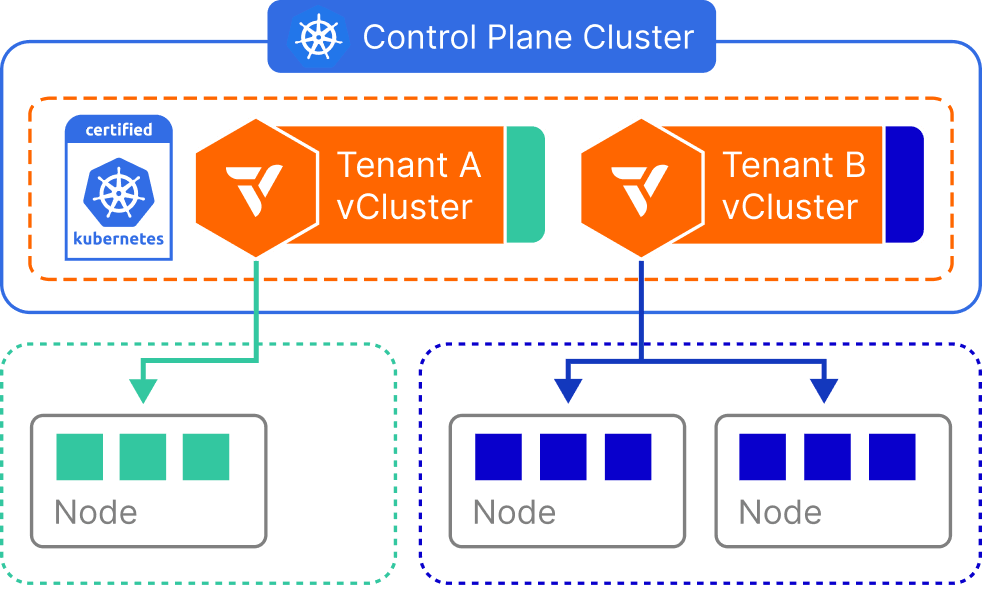
Each customer gets their own API server, etcd, scheduler, and RBAC running as a lightweight pod on your control plane cluster. Marginal cost per tenant is near zero, which is what makes an entry tier worth selling.

  • Own API server per tenant
  • Ready in seconds
  • Near-zero cost per tenant
Standards

Vanilla Kubernetes, Not a Platform Flavor

Every tenant cluster is fully CNCF-conformant with 100% API compatibility. Customers arriving from EKS or GKE keep the tooling they already use, install their own CRDs and operators, and have nothing new to learn.

  • 100% Kubernetes API compatibility
  • Full cluster-admin per tenant
  • Own CRDs and operators
Hardware Isolation

Dedicated GPU Nodes With Their Own CNI

Private Nodes, the production default, join dedicated physical nodes into each tenant cluster over an encrypted WireGuard VPN. Every tenant runs their own CNI, so one customer can use SR-IOV with Multus for RDMA while another runs Calico with eBPF.

  • Dedicated GPU nodes per tenant
  • Per-tenant CNI and CSI
  • RDMA and InfiniBand ready
Kubernetes Layer

One Binary on Plain Linux

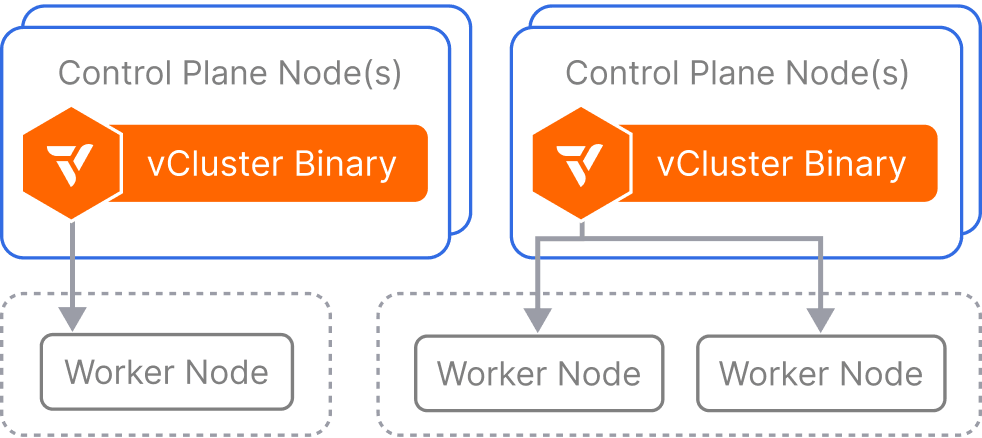
vCluster Standalone is a CNCF-certified control plane that runs as a single binary directly on Linux, with no k3s, kubeadm, or other base distribution underneath. A lean Kubernetes layer for hardware you sell by the hour.

  • Single binary on Linux
  • No k3s or kubeadm
  • CNCF-certified control plane
Platform Operations

Hundreds of Tenants From One Console

Run every tenant cluster from a single UI, CLI, and API, with SSO, quotas, and RBAC across the fleet. Templates codify each tier, so a customer picking a plan lands on exactly the configuration you defined.

  • One console, every tenant
  • SSO, quotas, and RBAC
  • Templates per tier

Why vCluster

This isn’t a side project. Behind every vCluster deployment is 5+ years of deep K8s engineering, security hardening, and battle-tested infrastructure work at massive scale.

100K+
GPU Nodes Powered
50+
GPU Clouds & F500s
<45
Days to Launch
30K
GitHub Stars

Get Started in 3 Steps

1
Schedule a Demo

Talk to our team about your stack

2
Deploy vCluster

Deploy vCluster on your infra in minutes

3
Onboard Your Tenants

Go live with a hyperscaler-grade tenant experience in days

FAQs

Why do GPU clouds look for an OpenShift alternative?

OpenShift was designed to deliver applications to an organization's own developers. Selling GPU capacity is a different business: your tenants are external customers who want a Kubernetes cluster and their own tooling rather than a platform. In our analysis, that mismatch is what starts the search. vCluster gives each customer vanilla, CNCF-certified Kubernetes on your hardware, with Private Nodes as the production default for dedicated GPU nodes.

Does OpenShift support hosted control planes?

Yes. Hosted control planes run tenant control planes on a management cluster, which settles where a control plane lives. The management cluster is itself an OpenShift cluster and each hosted cluster is a full OpenShift cluster, so the platform and its subscription follow every tenant. vCluster tenant clusters are vanilla CNCF-certified Kubernetes, which is what AI teams arriving from EKS or GKE expect to be handed.

How does tenant isolation compare?

vCluster offers a spectrum. Private Nodes, the production default, give each tenant dedicated physical nodes with their own CNI and CSI, joined privately over an encrypted WireGuard VPN, so no other tenant schedules onto that hardware. Shared nodes serve development, testing, CI/CD, and trusted teams. vNode layers kernel-native workload isolation using seccomp, cgroups, namespaces, and AppArmor over either model.

Can each tenant run a different CNI?

Yes, with Private Nodes. Each tenant cluster runs its own CNI and storage, so one customer can run SR-IOV with Multus for RDMA over InfiniBand while another runs Calico with eBPF and a third runs KubeOVN. For AI clouds selling high-performance interconnect, that flexibility decides which workloads you can take.

Is vCluster a conformant Kubernetes distribution?

Yes. Every tenant cluster is CNCF-certified with 100% API compatibility and listed in the Kubernetes conformance repository, with conformance tests run for every major and minor release. Tenants get full cluster-admin rights and install their own CRDs, operators, and GPU tooling without affecting anyone else.

How quickly can we launch a managed Kubernetes service?

Boost Run launched a managed Kubernetes offering in under 45 days with no new platform engineering hires, and Lintasarta launched a GPU cloud in Indonesia in 90 days. vMetal handles bare metal provisioning from PXE boot through OS installation and network automation via Netris, with vCluster Standalone running as a single binary on top, so the path from rack to tenant cluster is one stack.

See the OpenShift Alternative in Action

See how GPU clouds sell vanilla Kubernetes on their own hardware.