platform-eng

Multi-Tenant Kubernetes, Priced by Tier

Not every tenant needs the same boundary, and charging as if they did leaves margin on the table. vCluster runs shared nodes for dev and CI, Private Nodes for production, and vNode for tenants that need kernel-level hardening, all on one GPU fleet behind one control plane.

Trusted by the fastest-growing AI cloud providers
Problem

One Isolation Model Can't Serve Every Tenant

Commit to a single tenancy model and you either overspend on your cheapest customers or under-protect your most demanding ones.

One Model Means One Price

A platform built on a single tenancy model has one cost structure. Your dev tier carries production overhead, and your margin goes with it.

Namespaces Only Stretch So Far

Namespace boundaries suit internal teams who already trust each other. Paying customers running arbitrary workloads on your GPUs need a real boundary.

A Cluster Per Customer Breaks the Math

Separate physical clusters give you the boundary and multiply hardware cost, ops burden, and onboarding time with every tenant you add.

Solution

Match the Boundary to the Customer

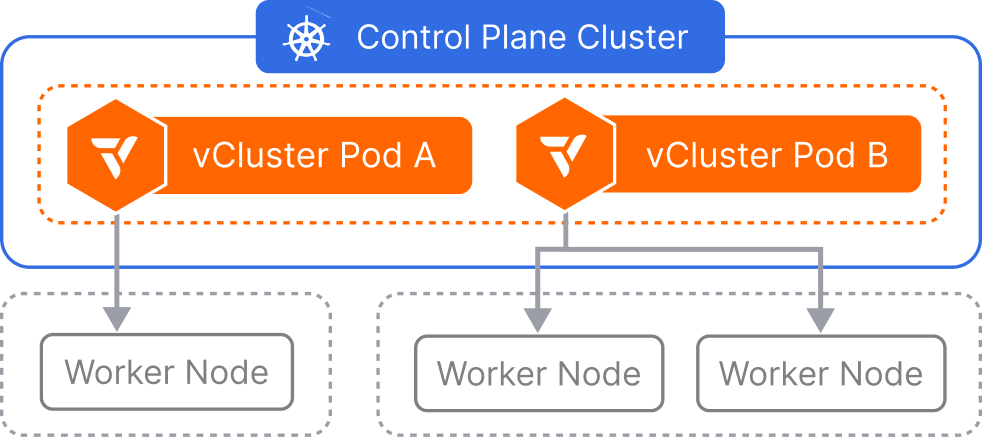
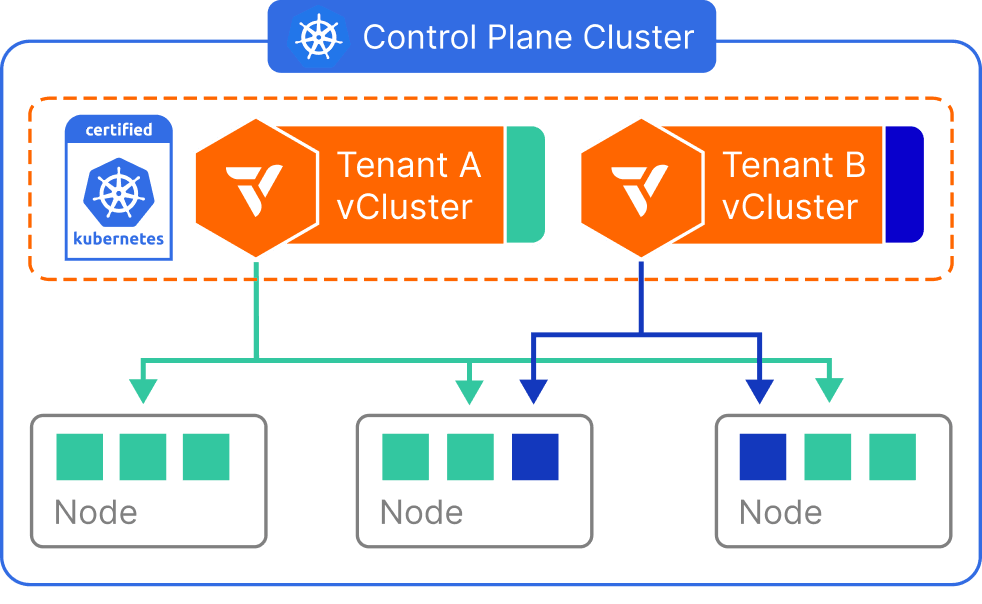
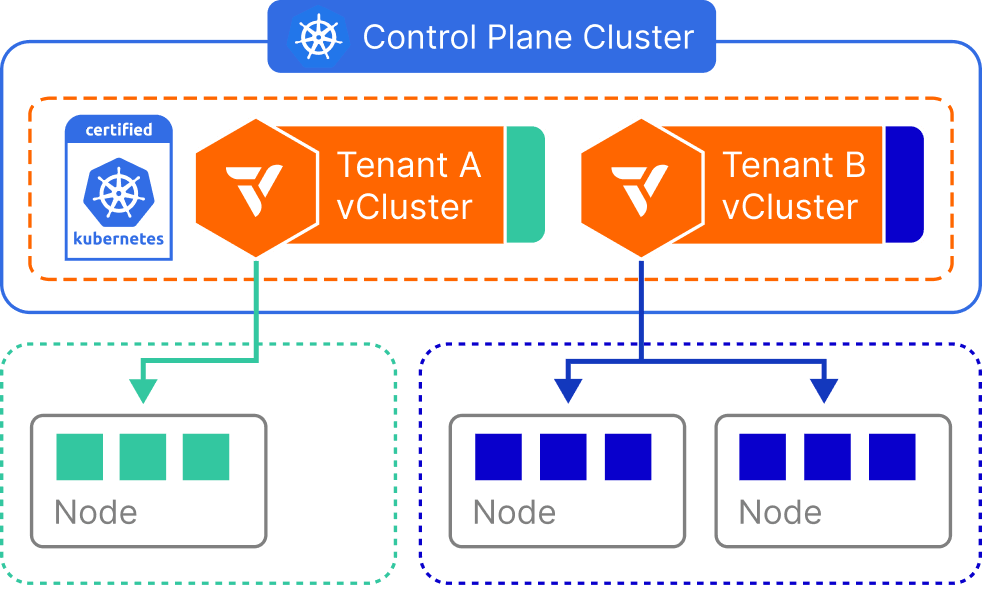
vCluster virtualizes the Kubernetes control plane, so every tenant gets a real, CNCF-certified cluster with its own API server, etcd, and RBAC whichever tier they buy. Underneath, the node model is yours to choose: shared nodes for dev, test, CI/CD, and trusted teams; Private Nodes, the production default, for dedicated hardware with per-tenant CNI and storage; vNode for tenants that need kernel-level hardening. One fleet, one control plane, three price points. Proven across 100K+ GPU nodes and 50+ GPU clouds.

Every Tier on One Multi-Tenant Kubernetes Fleet

The control plane stays the same for every tenant. What changes is where their workloads land and how hard the boundary is.

Control Plane

A Real Cluster in Every Tier

Each tenant gets their own CNCF-certified API server, etcd, scheduler, and RBAC running as a lightweight pod. The tier they pay for changes the nodes underneath, not the Kubernetes they get.

  • Own API server per tenant
  • Seconds to provision
  • Same cluster in every tier
Entry Tier

Shared Nodes for Dev, Test, and CI

Several tenants schedule onto the same physical GPU nodes with namespace boundaries and resource quotas enforced at the platform level. The most cost-efficient model, suited to development, testing, CI/CD, and trusted internal teams.

  • Highest GPU density
  • Quotas enforced per tenant
  • Dev, test, CI, trusted teams
Production Tier

Private Nodes as the Production Default

Dedicated physical nodes join each tenant cluster privately over an encrypted WireGuard VPN, with their own CNI and CSI. No other tenant schedules onto that hardware, so GPU performance stays predictable.

  • Dedicated GPU nodes per tenant
  • Own CNI and CSI
  • No noisy-neighbor contention
Hardened Tier

vNode for Kernel-Level Hardening

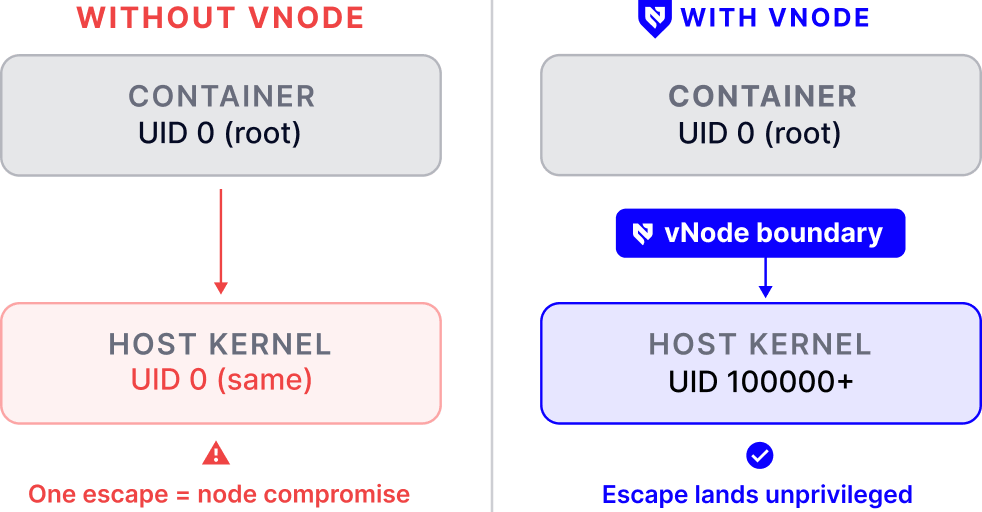
vNode wraps each workload in its own runtime using seccomp, cgroups, namespaces, and AppArmor, giving container breakout protection at bare metal GPU speed. Layer it over either node model for tenants that need more.

  • Container breakout protection
  • No hypervisor tax
  • Works with either node model
Platform Operations

Every Tier from One Console

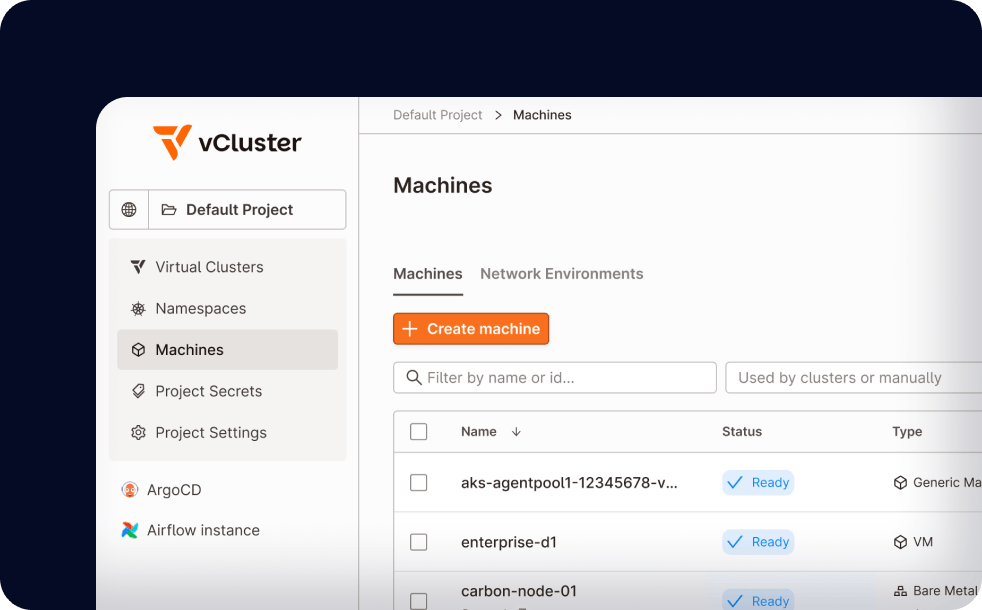
Manage all tenant clusters across all tiers from a single UI, CLI, and API. Templates codify each tier, so a customer picking a plan gets exactly the configuration you defined, with SSO, quotas, and RBAC applied fleet-wide.

  • Templates per tier
  • SSO, quotas, and RBAC
  • One console, every tenant

Why vCluster

This isn’t a side project. Behind every vCluster deployment is 5+ years of deep K8s engineering, security hardening, and battle-tested infrastructure work at massive scale.

100K+
GPU Nodes Powered
50+
GPU Clouds & F500s
<45
Days to Launch
30K
GitHub Stars

Get Started in 3 Steps

1
Schedule a Demo

Talk to our team about your stack

2
Deploy vCluster

Deploy vCluster on your infra in minutes

3
Onboard Your Tenants

Go live with a hyperscaler-grade tenant experience in days

FAQs

What is multi-tenant Kubernetes?

Multi-tenant Kubernetes means running workloads for several independent customers or teams on shared infrastructure while keeping each one separated from the others. The models differ in where the boundary sits: namespaces divide a single cluster, separate clusters give each tenant their own hardware and control plane, and control-plane virtualization gives each tenant a real cluster on shared infrastructure. vCluster takes the third approach and lets you vary the node model per tenant.

Which tenancy model should each tenant get?

Match it to trust. Shared nodes suit development, testing, CI/CD, and internal teams you already trust, and they deliver the highest GPU density. Private Nodes are the production default and assign dedicated physical nodes with per-tenant CNI and storage, which is what paying customers running arbitrary workloads need. vNode layers kernel-native workload isolation over either model for tenants with stricter requirements.

Is namespace isolation enough for multi-tenant Kubernetes?

No. Namespaces share one API server, one etcd, and one set of cluster-wide resources, so tenants can see platform internals and a misconfiguration in one namespace can reach others. Every vCluster tenant gets a separate control plane whichever tier they are on, so even the shared-node entry tier gives each tenant their own API server. For external customers running arbitrary workloads, Private Nodes moves the boundary into hardware.

Can tenants move between tiers?

Templates define each tier as a versioned configuration, so moving a customer up a tier means provisioning their cluster from a different template. Tier changes are planned as a new cluster with workloads migrated across, which leaves the running environment untouched until the switch.

Does multi-tenant Kubernetes cost GPU performance?

Control planes run as lightweight pods, so there is no hypervisor layer or VM tax between workloads and the GPU. On Private Nodes the tenant has the hardware to themselves, so GPU throughput matches bare metal. vNode adds workload isolation using kernel-native mechanisms rather than VMs, which keeps that performance intact.

How many tenants can one control plane cluster run?

Hundreds. Control planes are lightweight pods with near-zero marginal cost per tenant, which is what makes tiering viable: the entry tier can be priced low because it costs little to run. vCluster is proven across 100K+ GPU nodes and 50+ GPU clouds, with customers running hundreds of tenant clusters in production.

Build Every Tier on One Fleet

See how vCluster runs dev, production, and hardened tenants on the same GPU infrastructure.