platform-eng

Kubernetes GPU Sharing, Safe Enough to Sell to Tenants

GPU sharing splits the hardware between workloads. Splitting the cluster between customers is a different problem. vCluster gives every tenant their own API server, RBAC, and control plane on the same GPU fleet, with Private Nodes (the production default) assigning dedicated worker nodes per tenant.

Trusted by the fastest-growing AI cloud providers
Problem

Where Kubernetes GPU Sharing Breaks Down

Dividing a GPU is well understood. Handing the pieces to customers who don't trust each other is where teams get stuck.

A GPU Slice Has No Owner

MIG, vGPU, and time-slicing divide GPU capacity between workloads. Nothing in that layer decides which customer a slice belongs to, or what happens when one of them misbehaves.

Every Tenant Still Shares One API Server

Namespace boundaries still let tenants see cluster-wide agents, nodes, and each other's workloads, however finely you slice the GPUs underneath.

A Cluster Per Tenant Defeats the Point

Provisioning separate physical clusters restores the boundary but erases the density gains that made GPU sharing worth doing.

Solution

The Tenant Boundary Around Your Shared GPUs

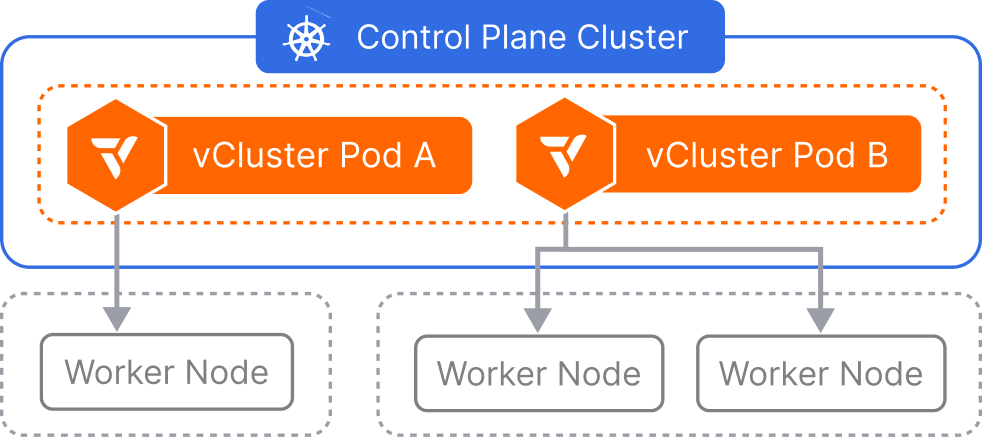
GPU sharing stays where it belongs, with MIG, vGPU, time-slicing, and DRA at the GPU layer. vCluster works above that: each tenant gets a real, CNCF-certified Kubernetes cluster with its own API server, etcd, and RBAC, running as a lightweight pod on your shared GPU fleet. For production tenants, Private Nodes (the production default) assign dedicated worker nodes with per-tenant CNI and storage. Production-proven across 100K+ GPU nodes.

Built for Kubernetes GPU Sharing at Tenant Scale

vCluster layers over whatever GPU partitioning you already run. Control plane, node model, workload runtime, and conformance, each matched to how much you trust the tenant.

Control Plane

A Real Cluster Per Tenant, Same GPU Fleet

Each tenant gets their own Kubernetes API server, etcd, scheduler, and RBAC as a lightweight pod. They share the GPU hardware underneath and nothing else: no visibility into other tenants' nodes, workloads, or your platform internals.

  • Own API server per tenant
  • Seconds to provision
  • No shared blast radius
Node Isolation

Dedicated Nodes for Production Tenants

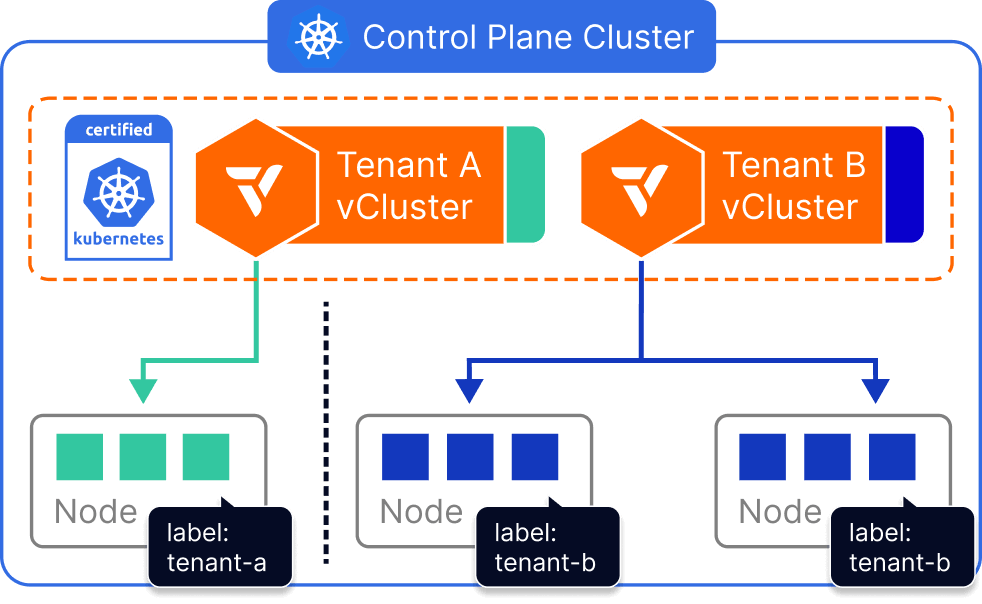
Private Nodes, the production default, joins dedicated worker nodes into each tenant cluster over an encrypted WireGuard VPN, with per-tenant CNI and storage. No cross-tenant scheduling, and isolation that approaches a dedicated physical cluster.

  • Dedicated GPU nodes per tenant
  • Own CNI and CSI per tenant
  • Zero noisy-neighbor contention
Resource Efficiency

Shared Nodes for Dev, Test, and Trusted Teams

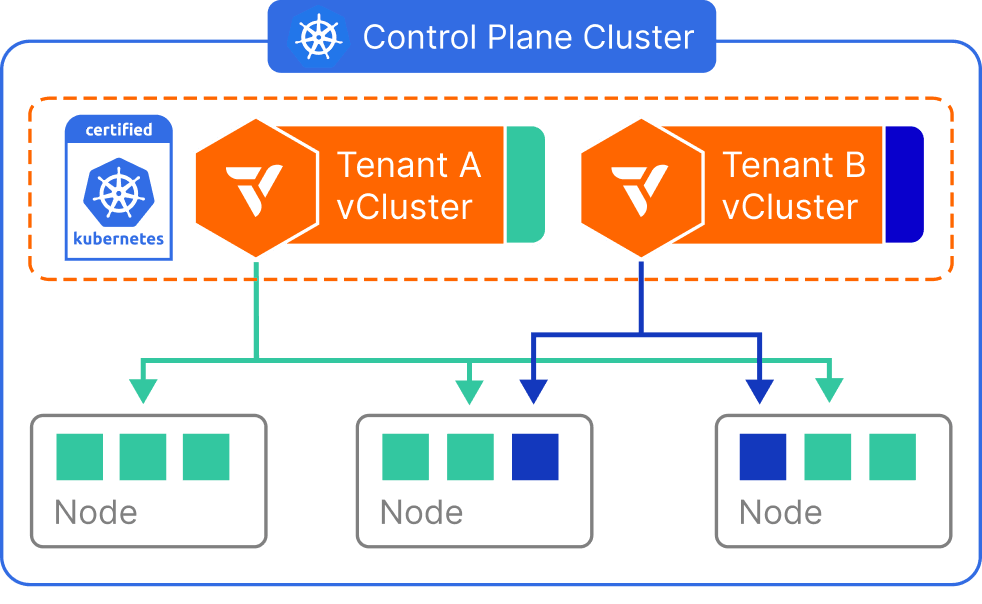
Where density matters more than a hard boundary, tenants share GPU nodes with quotas enforced at the platform level, layered over whatever partitioning you run: Run:AI, MIG, or time-slicing. Suited to development, testing, CI/CD, and trusted internal teams.

  • Maximum GPU density
  • Works with Run:AI, MIG, time-slicing
  • Quotas enforced per tenant
Workload Security

Kernel-Native Workload Hardening

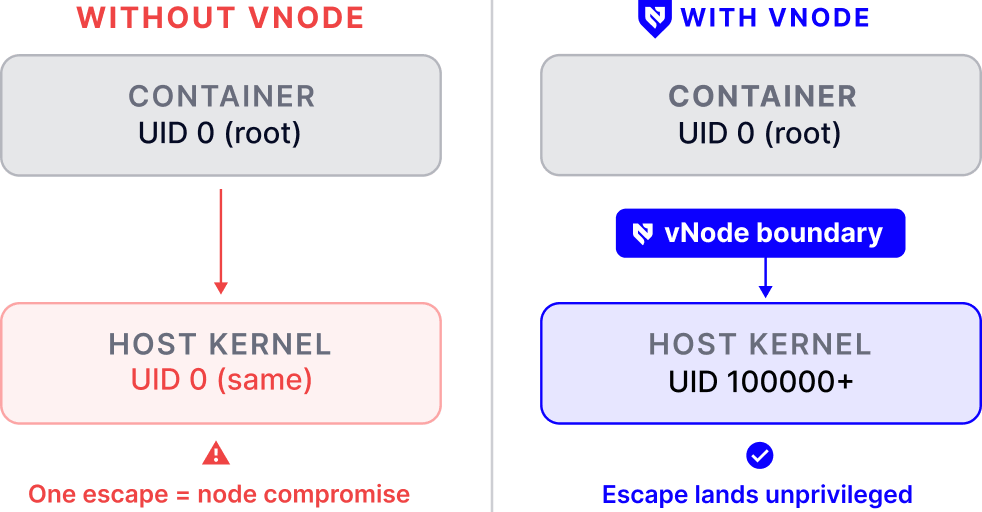
vNode wraps each workload in kernel-native isolation using seccomp, cgroups, namespaces, and AppArmor, giving container breakout protection at bare metal GPU speed. It hardens the workload itself; the GPU stays partitioned by MIG, vGPU, or DRA.

  • Container breakout protection
  • No hypervisor tax
  • Compatible with gVisor and Kata
Standards Compliance

Tenants Run Their Own GPU Stack

Every tenant cluster is CNCF-certified and comes with cluster-admin rights, so tenants install their own GPU operator, device plugin, and MIG profiles without touching your control plane cluster or anyone else's configuration.

  • Own GPU operator per tenant
  • Full CRD and operator support
  • 100% Kubernetes API compatibility

Why vCluster

This isn’t a side project. Behind every vCluster deployment is 5+ years of deep K8s engineering, security hardening, and battle-tested infrastructure work at massive scale.

100K+
GPU Nodes Powered
50+
GPU Clouds & F500s
<45
Days to Launch
30K
GitHub Stars

Get Started in 3 Steps

1
Schedule a Demo

Talk to our team about your stack

2
Deploy vCluster

Deploy vCluster on your infra in minutes

3
Onboard Your Tenants

Go live with a hyperscaler-grade tenant experience in days

FAQs

What is Kubernetes GPU sharing?

GPU sharing lets multiple workloads use the same physical GPU. It happens at the GPU layer through MIG (Multi-Instance GPU), vGPU, time-slicing, and DRA (Dynamic Resource Allocation), often driven by a scheduler such as Run:AI. Those mechanisms decide how GPU capacity gets divided. Ownership of each slice is a separate, Kubernetes-level question, and that's where most teams looking into GPU sharing actually get stuck.

Does vCluster do GPU sharing?

No. GPU partitioning is handled by MIG, vGPU, time-slicing, and DRA. vCluster is the isolation envelope layered over them: each tenant gets a genuine Kubernetes cluster, so the partitions you hand out land inside a real boundary with their own API server, RBAC, and, with Private Nodes, their own hardware. It complements a GPU sharing strategy rather than competing with one.

What isolation options exist for tenants sharing GPU nodes?

vCluster supports a flexible isolation spectrum. Private Nodes, the production default, assigns dedicated worker nodes joined privately into each tenant cluster with per-tenant CNI and storage, which removes noisy-neighbor contention. Shared Nodes put several tenants on the same GPU hardware with resource quota boundaries, suited to dev, test, CI/CD, and trusted-team workloads. vNode adds kernel-native workload isolation using seccomp, cgroups, and AppArmor for container breakout protection across either model.

Does vCluster add overhead to shared GPU performance?

vCluster control planes run as lightweight pods with minimal overhead. There is no hypervisor layer or VM tax between workloads and the GPU. Combined with vNode for workload isolation, the stack relies on kernel-native mechanisms like cgroups and namespaces rather than full VMs, so bare metal GPU throughput is preserved. vCluster powers 100K+ GPU nodes in production across 50+ GPU cloud customers.

Can tenants install their own GPU operators and MIG profiles?

Yes. Every tenant cluster is a fully CNCF-certified Kubernetes environment with cluster-admin permissions. Tenants can install their own CRDs, GPU operators, device plugins, MIG configuration, and RBAC policies without affecting other tenants or the underlying control plane cluster. CRD and resource syncing between the tenant cluster and the control plane cluster is also supported for advanced configurations.

Is vCluster used in production GPU clouds today?

Yes. vCluster powers 100K+ GPU nodes in production and is deployed across 50+ GPU cloud providers and Fortune 500 customers, including CoreWeave and Nscale. It is named in the NVIDIA DGX SuperPOD reference architecture.

Share the GPUs, Keep the Boundary

See how vCluster puts a real tenant boundary around your shared GPU fleet.