Kubernetes GPU Scheduling for Multi-Tenant Clusters
Stop tenant resource contention. Effective Kubernetes GPU scheduling requires full isolation, not just namespaces. vCluster gives each tenant a dedicated scheduler and control plane.
Namespace-level isolation cannot solve the fundamental contention problems in shared GPU clusters.
Tenants share a scheduler, API server, and node pool. One noisy workload degrades GPU performance for everyone.
Provisioning a full physical cluster per tenant multiplies infrastructure cost and slows time to production significantly.
A shared cluster-wide scheduler cannot enforce fair GPU allocation across isolated tenants without interference.
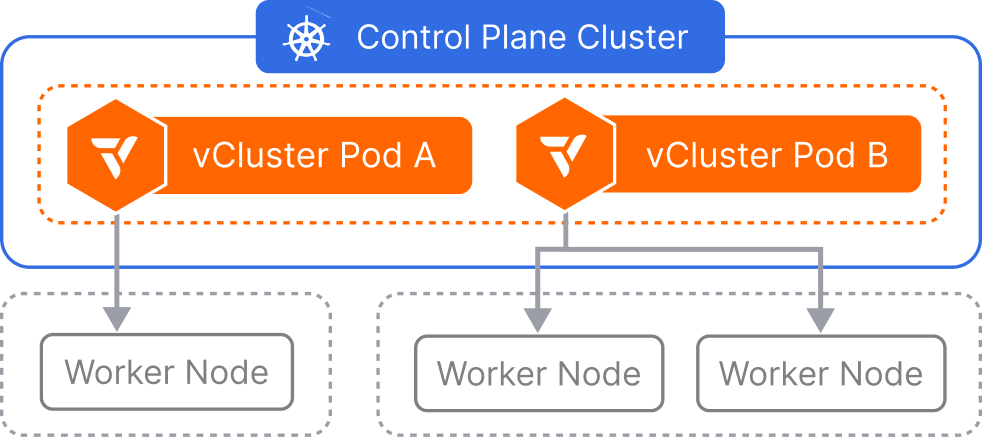
vCluster gives each tenant a fully isolated, CNCF-certified Kubernetes cluster with its own API server, etcd, and scheduler running as a lightweight pod. Kubernetes GPU scheduling decisions stay within each tenant boundary, eliminating cross-tenant contention at the control plane level. Proven across 100K+ GPU nodes in production.
vCluster isolates every layer of Kubernetes GPU scheduling — from the control plane to bare metal nodes — without sacrificing resource efficiency.
Each tenant cluster runs its own Kubernetes API server, etcd, and scheduler as lightweight pods. GPU scheduling decisions are tenant-scoped, eliminating interference from other workloads on the same host cluster.

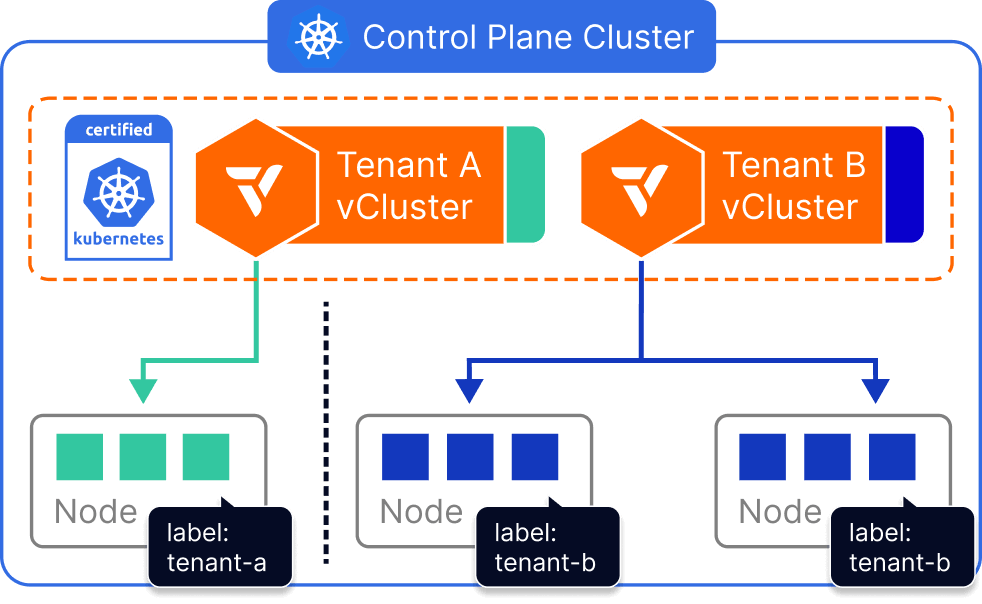
Assign dedicated physical GPU nodes to specific tenants, eliminating the noisy-neighbor problem. Tenants cannot consume GPU resources provisioned for another team, delivering predictable, contention-free scheduling outcomes.

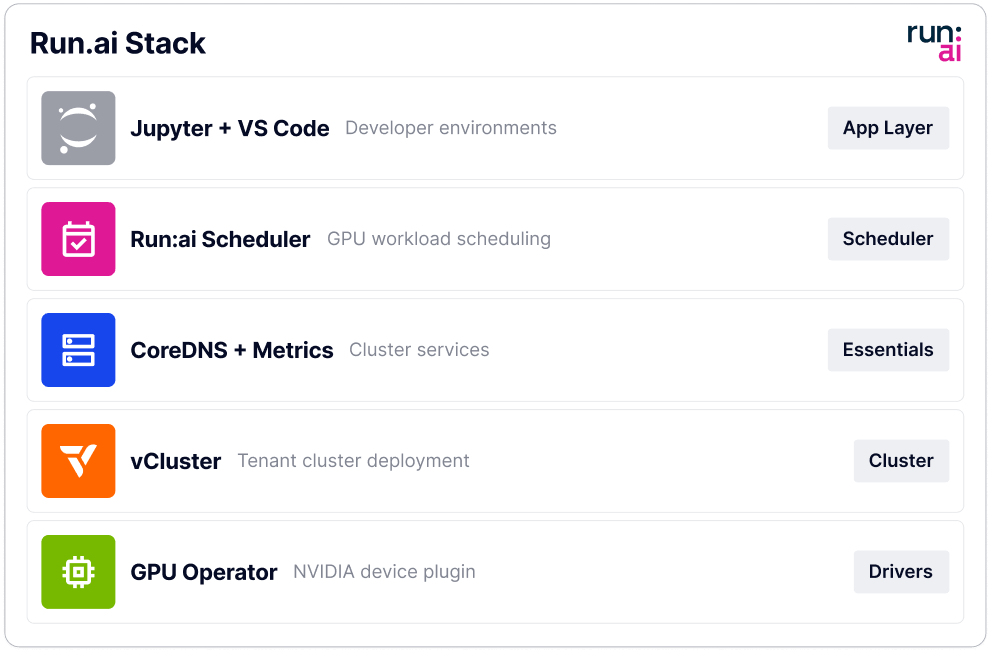
Pre-certified AI environments with Run:AI, Ray, and Jupyter layer on top of tenant isolation. Go from a bare Kubernetes cluster to a production GPU scheduling platform in minutes, not weeks.

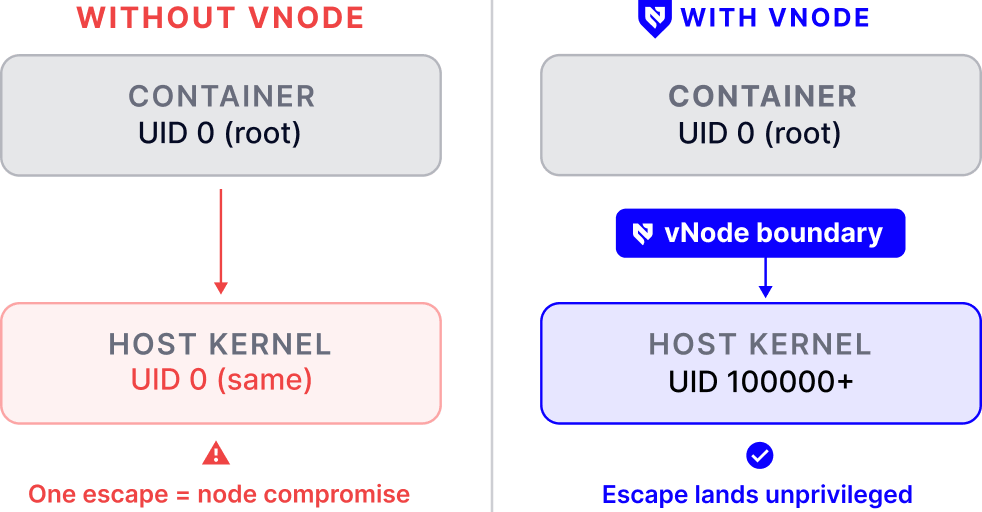
vNode (currently in private beta) adds kernel-native isolation per workload using seccomp, cgroups, namespaces, and AppArmor. Prevent container breakouts without hypervisor overhead, preserving bare metal GPU performance for every scheduled workload.

Manage all tenant clusters from a single control plane with a unified UI, CLI, and API. Apply quotas, templates, and SSO across your entire GPU scheduling fleet without touching individual tenant environments.

This isn’t a side project. Behind every vCluster deployment is 5+ years of deep K8s engineering, security hardening, and battle-tested infrastructure work at massive scale.
Talk to our team about your stack
Deploy vCluster on your infra in minutes
Go live with a hyperscaler-grade tenant experience in days
vCluster gives every tenant their own dedicated Kubernetes scheduler running as a lightweight pod inside the host cluster. This means GPU scheduling decisions are scoped entirely to each tenant's cluster, preventing cross-tenant starvation, priority inversion, and noisy-neighbor contention. Unlike namespace-level partitioning, each tenant has a real API server and etcd — so scheduler state never leaks between tenants. The result is predictable, interference-free Kubernetes GPU scheduling without provisioning separate physical clusters.
Namespace isolation shares a single Kubernetes scheduler, API server, and node pool across all tenants. Any tenant can submit workloads that compete for the same GPU nodes, and there is no scheduler-level separation to enforce priority. Tenant cluster isolation gives each tenant their own scheduler and control plane. GPU scheduling is decided independently per tenant, removing the structural cause of resource contention. vCluster delivers tenant cluster isolation as lightweight pods, not separate physical clusters.
Yes. Because each tenant cluster is a fully CNCF-certified Kubernetes distribution with 100% API compatibility, it supports all standard Kubernetes scheduling features including node selectors, affinity rules, resource limits, and extended resources for GPU devices. Tenants have cluster-admin access to configure their own scheduling policies, install GPU device plugins, and define custom CRDs — all without affecting other tenants or the host cluster.
Yes. vCluster supports a flexible isolation spectrum ranging from shared nodes to fully dedicated physical GPU nodes per tenant. With dedicated nodes, no other tenant's workloads can be scheduled onto those GPU servers, eliminating the noisy-neighbor problem entirely. This is configurable per tenant, allowing GPU cloud operators to offer tiered service levels based on isolation requirements and customer entitlements.
vCluster eliminates GPU resource contention at the control plane level by giving each tenant a separate scheduler that only sees and manages that tenant's node pool. Combine this with dedicated node assignment and vNode kernel-native workload isolation (currently in private beta), and you have a layered approach: scheduler isolation, node isolation, and workload isolation. Each layer independently prevents one class of contention, and together they provide full-stack interference-free GPU scheduling.
Yes. vCluster powers 100K+ GPU nodes in production across 50+ GPU cloud providers and Fortune 500 companies, including customers such as CoreWeave and Nscale. It is named in the NVIDIA DGX SuperPOD reference architecture. The open-source core has 29.8K GitHub stars and has been used to create 40M+ tenant clusters, making it one of the most widely deployed Kubernetes tenant isolation platforms available.
See how vCluster gives every tenant a dedicated scheduler on shared GPU infrastructure.