platform-eng
Kubernetes Control Plane as a Service for AI Clouds
Stop provisioning slow, expensive physical clusters. vCluster Platform delivers fully isolated, CNCF-certified tenant clusters with their own control planes in seconds.
Stop provisioning slow, expensive physical clusters. vCluster Platform delivers fully isolated, CNCF-certified tenant clusters with their own control planes in seconds.
Traditional Kubernetes provisioning breaks down at GPU cloud scale.
Tenants can see platform internals they should not: cluster-wide agents, other tenants' nodes and pods sharing the same blast radius.
Provisioning a full physical cluster per tenant is slow, resource-heavy, and blocks you from scaling without ballooning infrastructure costs.
Building a GPU cloud platform in-house requires significant engineering investment. It is a multi-year engineering commitment that delays time-to-market.
vCluster Platform virtualizes the Kubernetes control plane itself, each tenant gets a real API server, etcd, and RBAC running as a lightweight process. Hundreds of isolated tenant clusters on shared GPU infrastructure, with near-zero marginal cost per tenant. For production deployments, Private Nodes, dedicated worker nodes with per-tenant CNI and storage, deliver hardware-level isolation. Boost Run launched managed Kubernetes in under 45 days.
Purpose-built for AI cloud providers delivering isolated, CNCF-certified Kubernetes environments on GPU hardware at scale.
Each tenant gets their own Kubernetes API server, etcd, and scheduler running as a lightweight pod inside your control plane cluster. No physical cluster provisioning: just isolated tenant environments ready in seconds.
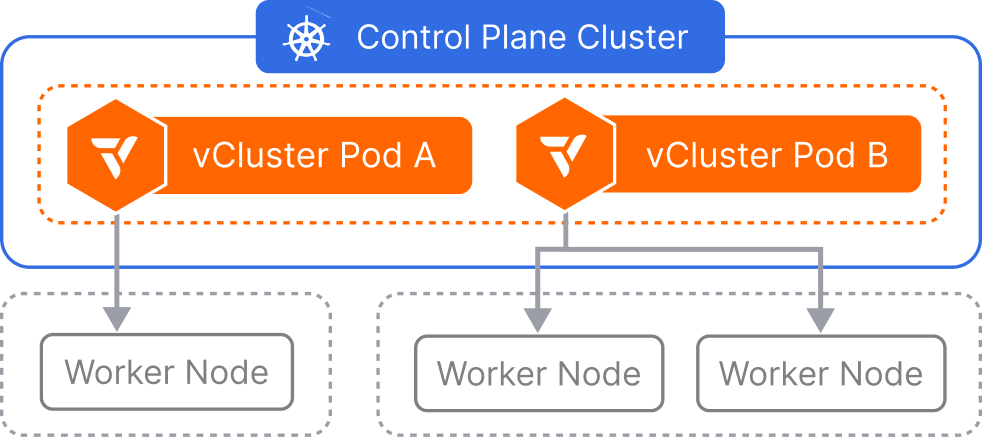
Every tenant cluster runs a fully CNCF-certified Kubernetes control plane. Full API compatibility means tenants run standard tooling without proprietary workarounds: the same Kubernetes experience they get on EKS or GKE.
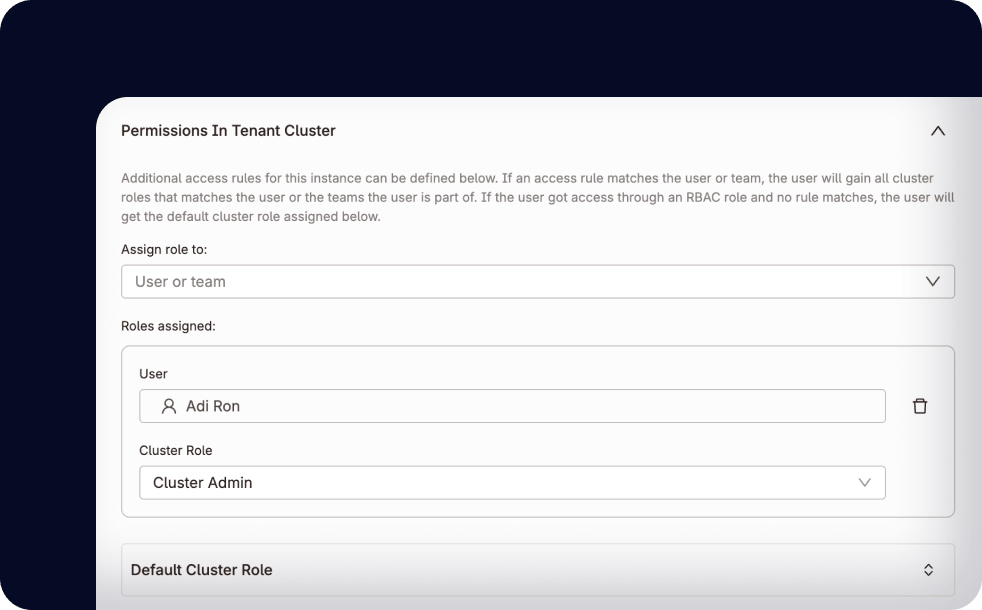
Every tenant gets cluster-admin access within their own environment: free to install CRDs, configure RBAC, and deploy operators without any impact on other tenants or your control plane infrastructure.
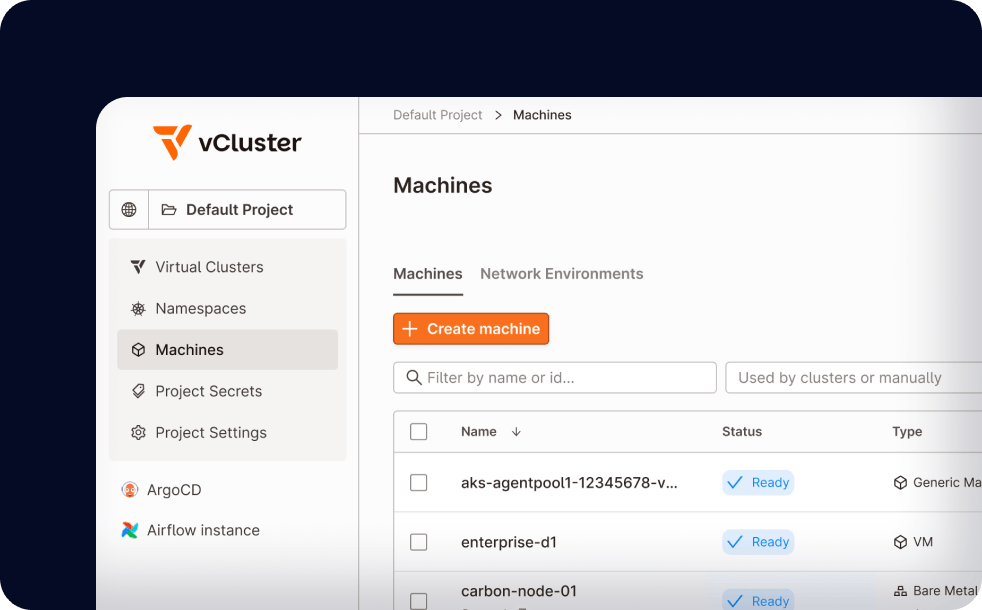
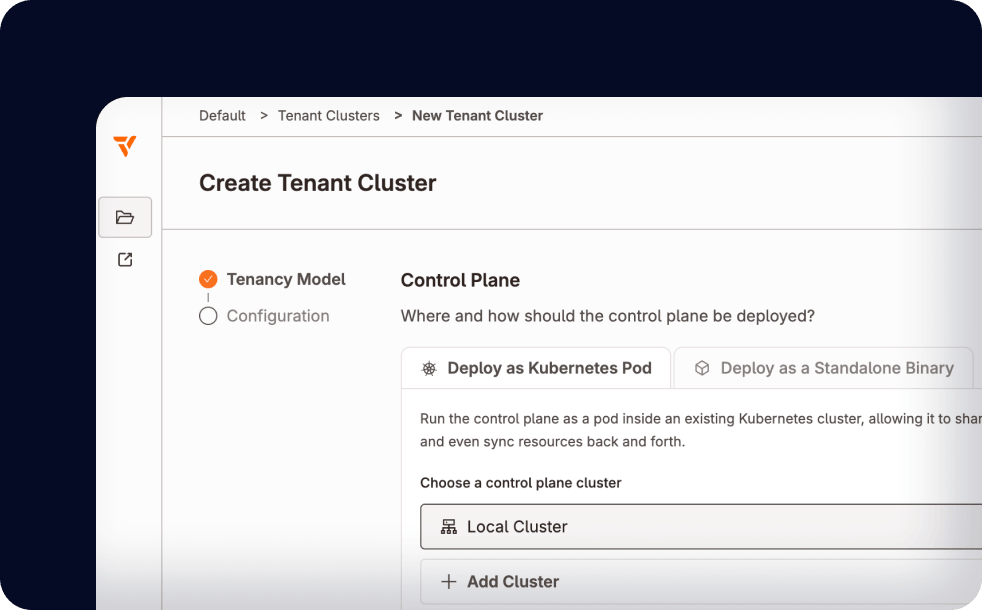
Manage every tenant cluster from a single UI, CLI, or API. Set quotas, enforce templates, configure SSO, and apply policies across your entire Kubernetes control plane fleet without touching individual clusters.
Give your end customers an EKS-like self-service experience. Tenants provision and manage their own Kubernetes environments through a branded portal, reducing your support burden while meeting cloud-native expectations.
This isn’t a side project. Behind every vCluster deployment is 5+ years of deep K8s engineering, security hardening, and battle-tested infrastructure work at massive scale.
Talk to our team about your stack
Deploy vCluster on your infra in minutes
Go live with a hyperscaler-grade tenant experience in days
Kubernetes control plane as a service means each tenant gets their own dedicated Kubernetes API server, etcd, and scheduler, without you provisioning a separate physical cluster for each one. vCluster achieves this by running tenant control planes as lightweight pods inside a shared control plane cluster. Every tenant environment is fully isolated and CNCF-certified, giving customers the complete Kubernetes experience at a fraction of the cost and time of traditional cluster provisioning.
Namespace isolation gives each tenant a partition within a shared control plane, meaning they share the same API server, etcd, and cluster-wide agents. With vCluster, each tenant gets their own dedicated control plane. That means true API server isolation, no shared blast radius, and full cluster-admin access per tenant. Tenants cannot see each other's resources, and a misconfiguration in one environment is strongly contained from affecting others. For production deployments, Private Nodes, dedicated worker nodes with per-tenant CNI and storage, deliver hardware-level isolation beyond the control plane.
Tenant clusters spin up in seconds because control planes run as lightweight pods: there is no physical hardware to provision, no PXE boot cycle, and no OS installation required. The control plane cluster is already running; vCluster simply launches a new isolated control plane process inside it. This is how Boost Run launched a full managed Kubernetes offering in under 45 days with a focused team.
Yes. Every tenant cluster created by vCluster is a fully CNCF-conformant Kubernetes control plane binary with 100% API compatibility. Tenants can use standard Kubernetes tooling, Helm charts, operators, and CRDs exactly as they would on any other certified distribution. This is not a proprietary abstraction: it is real Kubernetes running as a lightweight process inside your control plane cluster.
vCluster provides a flexible isolation spectrum: Private Nodes as the production default for fully dedicated physical hardware per tenant, Shared Nodes for cost-efficient isolated tenant workloads in dev, test, CI/CD, and trusted-team scenarios, and Dedicated VMs combined with vNode for workload isolation, providing consistent GPU performance with significantly reduced noisy-neighbor risk. You can also add vNode for workload isolation using seccomp, cgroups, and AppArmor, preserving near-bare-metal performance while preventing container breakouts.
Yes. vCluster Platform supports air-gapped and FIPS deployment for environments with strict compliance requirements. Control planes can also run as VMs instead of pods when tenants require OS-level separation. These options allow GPU cloud providers and enterprises to meet regulatory requirements without sacrificing the speed and density benefits of virtualized Kubernetes control planes.
See how AI cloud providers spin up hundreds of isolated tenant clusters in seconds.
