Bare Metal GPU Provisioning for AI Clouds
vMetal automates bare metal GPU provisioning and deploys isolated tenant clusters without VM overhead, so you go from racked servers to a production AI cloud in days.
Raw hardware alone cannot power the AI cloud your customers expect.
Selling bare metal GPUs alone commoditizes your offering. Customers want the full cloud experience, not just raw compute.
Based on industry estimates, building a GPU cloud platform typically requires 6 to 10 engineers, 6 to 12 months, and over one million dollars in investment.
Standard Kubernetes forces you to choose between tenant isolation and operational efficiency on bare metal GPU infrastructure.
vCluster delivers the complete path from bare metal GPU servers to isolated tenant Kubernetes environments. vMetal handles zero-touch provisioning, vCluster deploys CNCF-certified tenant clusters as lightweight processes, and vNode adds kernel-native workload isolation — all without hypervisor overhead. Proven across 100K+ GPU nodes in production.
Every layer of the stack is purpose-built for GPU cloud providers deploying bare metal infrastructure at production scale.
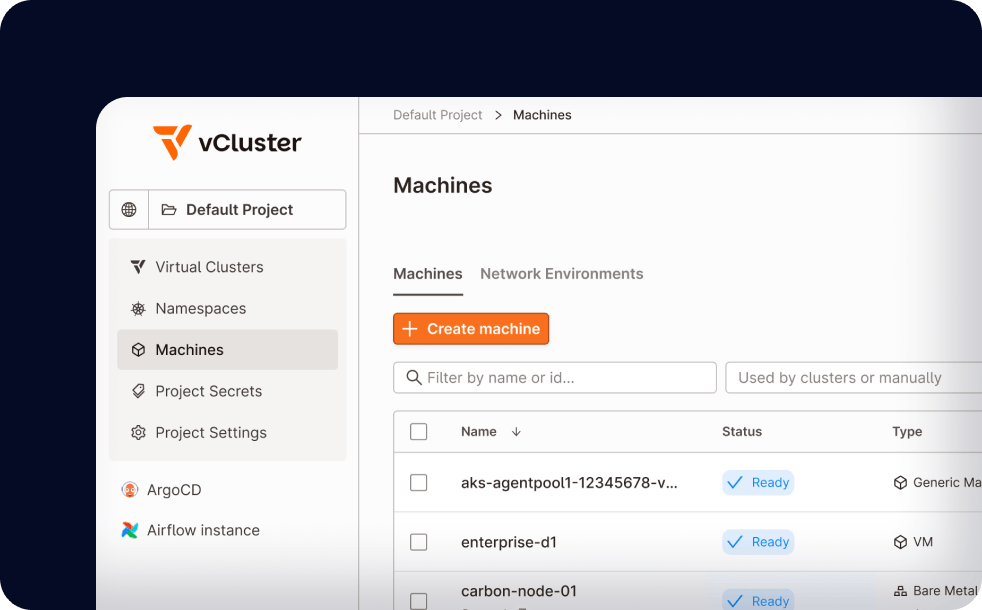
vMetal handles PXE boot, OS installation, machine registration, and full server lifecycle management. Go from racked GPU hardware to a production-ready Kubernetes base layer without manual intervention.

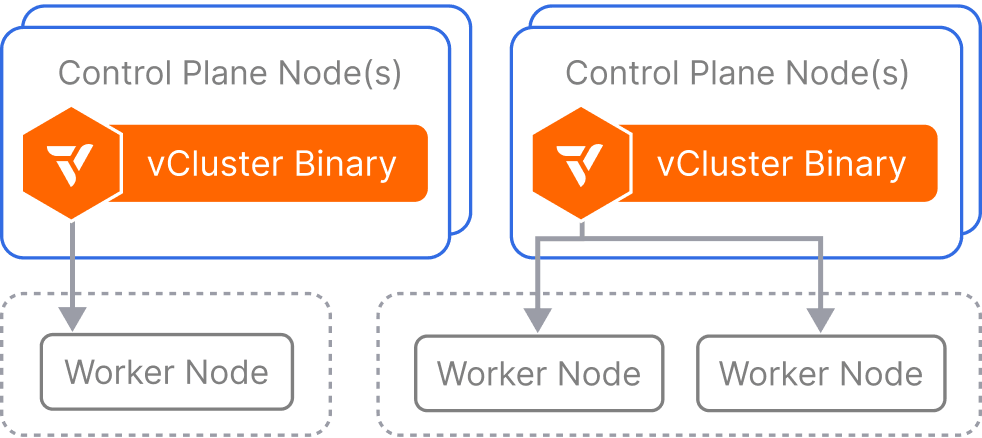
vCluster Standalone runs as a single binary directly on bare metal Linux. No k3s, kubeadm, or external Kubernetes dependency required — eliminating an entire layer of operational complexity.

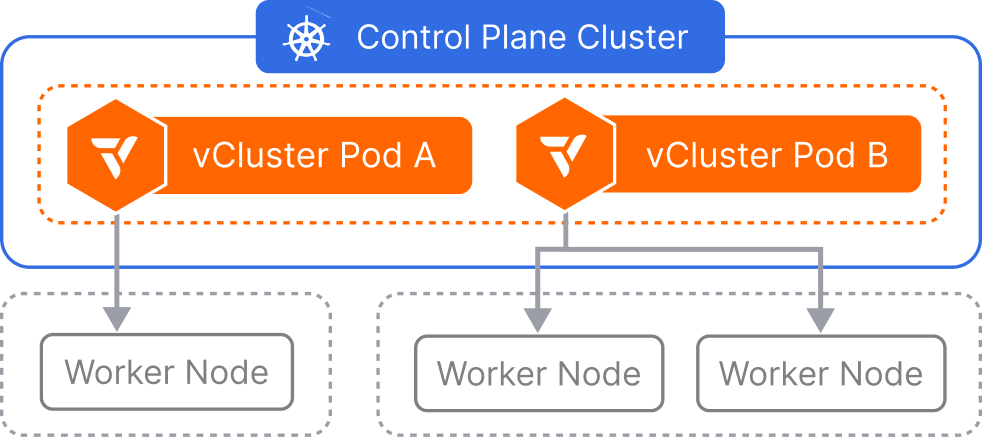
Each tenant gets their own CNCF-certified Kubernetes API server, etcd, and RBAC running as lightweight pods — no additional physical servers required. Deliver an EKS-like experience on your own bare metal GPU fleet.

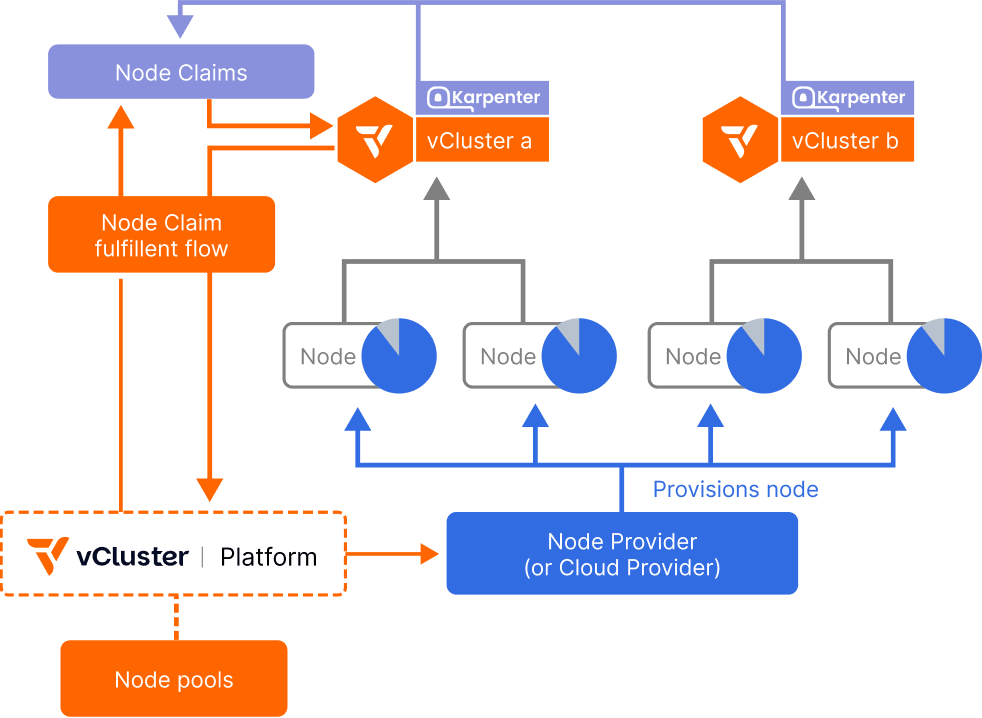
Auto Nodes acts as bare metal Karpenter — automatically provisioning GPU servers via Terraform when tenants schedule workloads. Scale physical bare metal GPU capacity dynamically without manual intervention.

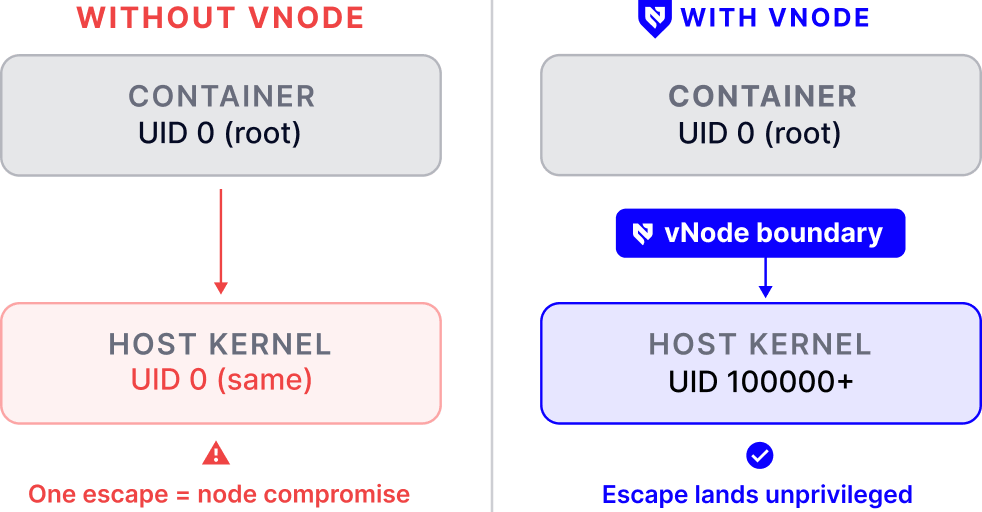
vNode (currently in private beta) uses seccomp, cgroups, namespaces, and AppArmor to isolate workloads at the kernel level. Container breakout protection at bare metal GPU performance — no hypervisor required.

This isn’t a side project. Behind every vCluster deployment is 5+ years of deep K8s engineering, security hardening, and battle-tested infrastructure work at massive scale.
Talk to our team about your stack
Deploy vCluster on your infra in minutes
Go live with a hyperscaler-grade tenant experience in days
Bare metal GPU provisioning means deploying Kubernetes and tenant workloads directly on physical GPU servers without a hypervisor or VM layer in between. This preserves full GPU performance for AI training and inference workloads. For AI cloud providers, it also means lower operational overhead and faster time to revenue compared to running nested virtualization stacks. vMetal automates the entire provisioning lifecycle — from PXE boot to production — so operators spend less time on infrastructure and more time serving customers.
vCluster runs each tenant's Kubernetes control plane as a lightweight process inside the host cluster. Every tenant gets their own API server, etcd, scheduler, and RBAC — without requiring a separate physical server per tenant. Combined with vMetal for bare metal lifecycle management and vNode (currently in private beta) for kernel-native workload isolation, the full stack delivers strong tenant isolation at bare metal GPU performance with near-zero marginal cost per additional tenant.
No. vCluster Standalone runs as a single binary directly on bare metal Linux. There is no dependency on k3s, kubeadm, or any external Kubernetes distribution as a base layer. vMetal handles the bare metal provisioning lifecycle — PXE boot, OS installation, network configuration — and vCluster Standalone provides the Kubernetes distribution that runs directly on that hardware.
Production timelines vary by infrastructure complexity, but vCluster has enabled AI cloud providers to move from bare metal GPU hardware to a live managed Kubernetes offering in weeks rather than months. Boost Run launched their managed Kubernetes service in under 45 days. Lintasarta launched Indonesia's leading GPU cloud in 90 days with 170+ isolated tenant clusters — without adding new platform engineering headcount. Based on industry experience, a DIY approach typically requires 6 to 10 engineers and 6 to 12 months.
Yes. vCluster powers 100K+ GPU nodes in production across 50+ GPU clouds and Fortune 500 customers, including CoreWeave and Nscale. The platform is named in the NVIDIA DGX SuperPOD reference architecture and referenced in the SemiAnalysis ClusterMax evaluation criteria. The open-source core has 29.8K GitHub stars and more than 40 million tenant clusters have been created on the platform.
vCluster integrates with Netris to deliver hardware-enforced network isolation per tenant. This includes VLANs, VXLANs, VRFs, ACLs, and DPU policy enforcement — giving each tenant dedicated network boundaries at the hardware level. This is particularly important for GPU cloud providers running untrusted or competing workloads on shared bare metal infrastructure, where namespace-level network policies alone are insufficient.
See how vCluster powers production AI clouds on bare metal GPU infrastructure.