ai-factory
The AI Factory Platform for GPU Clouds
Build your AI factory on shared bare metal GPU hardware. vCluster creates fully isolated, CNCF-certified tenant clusters in seconds without provisioning separate physical clusters.
Build your AI factory on shared bare metal GPU hardware. vCluster creates fully isolated, CNCF-certified tenant clusters in seconds without provisioning separate physical clusters.
Building a production-grade AI factory on GPU infrastructure exposes three hard problems.
Building a GPU cloud platform in-house requires significant engineering investment. Teams building GPU cloud platforms in-house often find the timeline extending well beyond initial estimates.
Standard Kubernetes forces you to choose between strong tenant isolation and operational efficiency. Namespace isolation is too weak. Separate clusters are too expensive.
AI teams have used AWS and GCP. They expect self-service environments, managed Kubernetes, and cloud-native tooling and will go back to a hyperscaler if you cannot deliver it.
vCluster delivers the complete AI factory infrastructure stack: zero-touch bare metal provisioning via vMetal, CNCF-certified tenant clusters via vCluster, and kernel-native workload isolation via vNode. Boost Run launched a managed Kubernetes service in under 45 days. Lintasarta launched a GPU cloud in Indonesia in 90 days.
From GPU rack provisioning to isolated tenant environments and pre-validated AI platforms, every layer your AI factory needs is included.
vMetal handles PXE boot, OS installation, machine registration, and network automation for GPU servers. Go from rack to production-ready Kubernetes nodes without manual configuration or external dependencies.
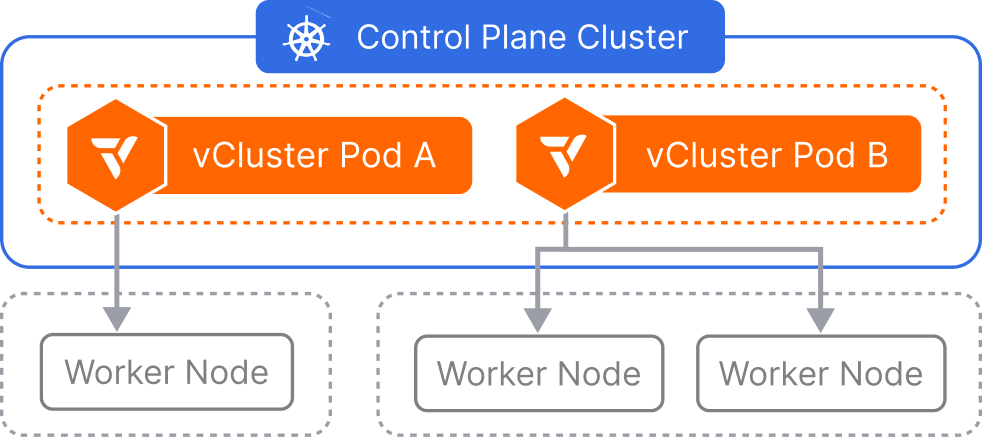
Every AI factory tenant gets their own Kubernetes API server, etcd, scheduler, and RBAC running as lightweight pods. For production workloads, Private Nodes give each tenant dedicated physical GPU nodes with per-tenant CNI and storage: hardware-level isolation approaching a dedicated physical cluster. The shared-hardware pod model is optimized for dev, test, and trusted-team environments.
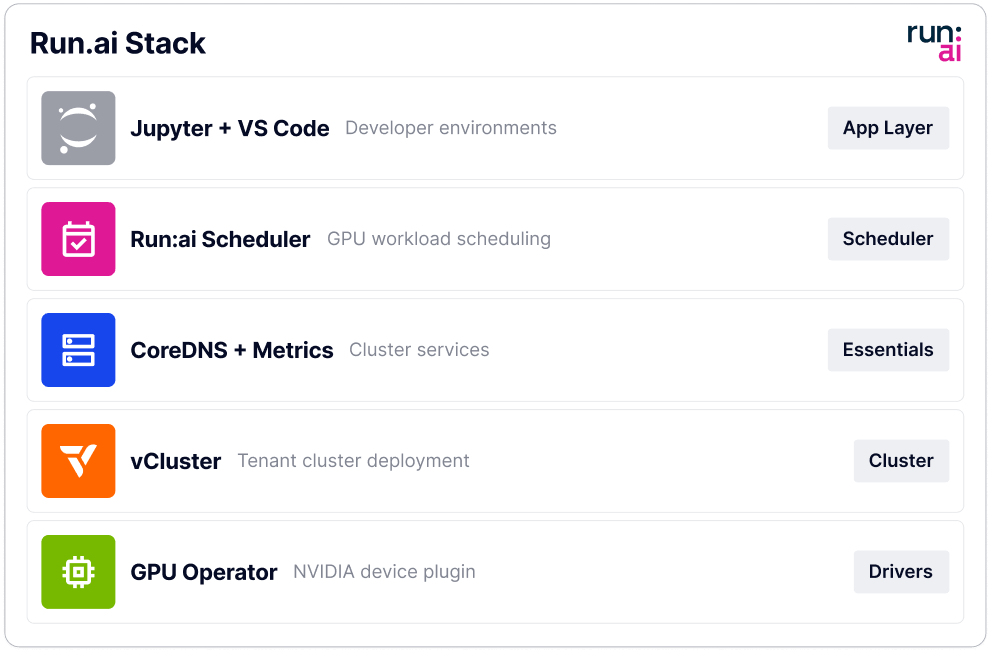
Turn a bare Kubernetes cluster into a production AI platform in minutes. Partner integrations with Run:AI, Ray, and Jupyter mean your AI factory tenants get a full platform environment without weeks of integration work.
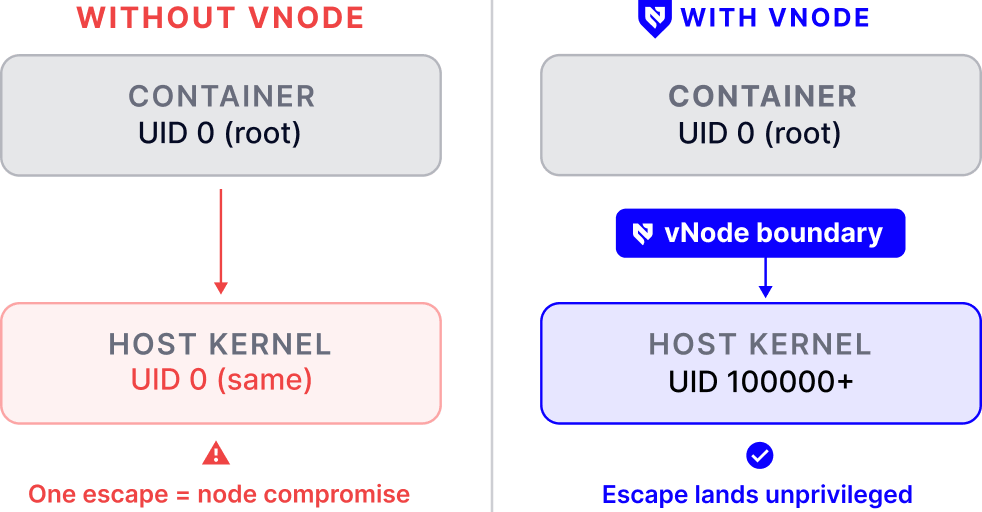
vNode delivers container breakout protection for AI factory workloads using seccomp, cgroups, namespaces, and AppArmor at the kernel level. Bare metal GPU performance is preserved with no hypervisor tax.
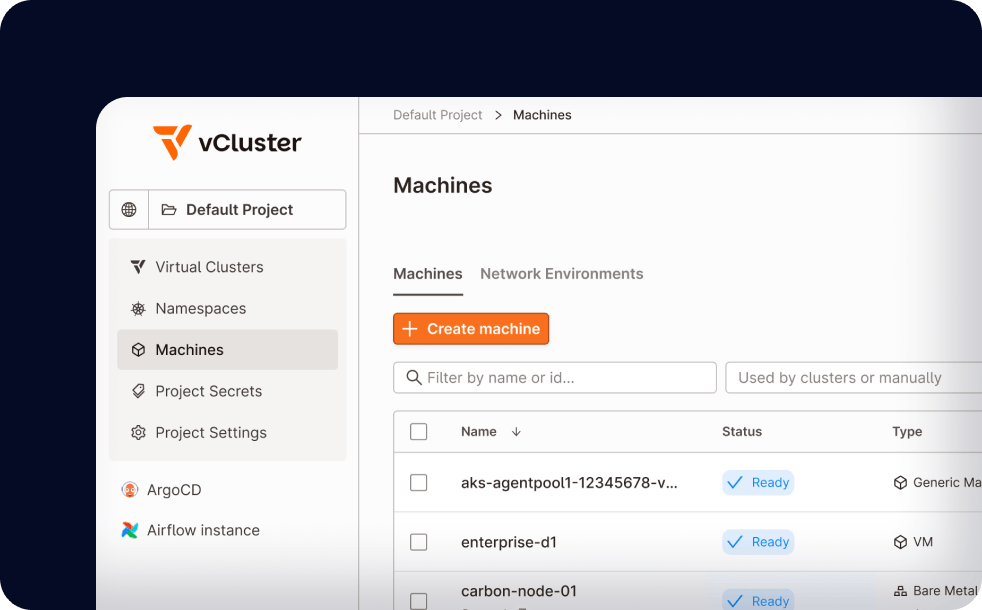
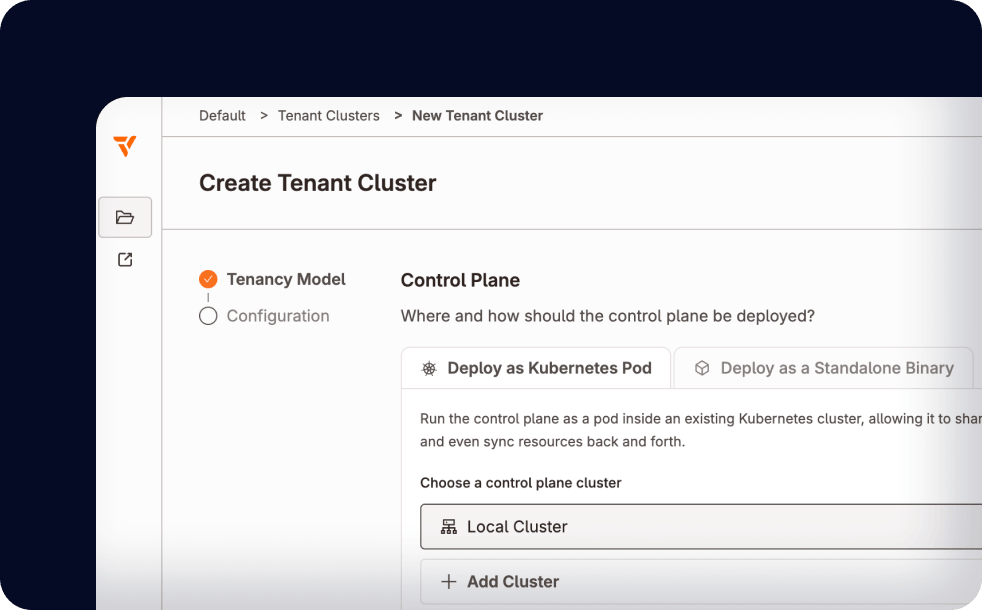
Give every AI factory team an EKS-like self-service experience. Tenants provision their own environments through a managed portal without waiting on platform engineering or filing infrastructure tickets.
This isn’t a side project. Behind every vCluster deployment is 5+ years of deep K8s engineering, security hardening, and battle-tested infrastructure work at massive scale.
Talk to our team about your stack
Deploy vCluster on your infra in minutes
Go live with a hyperscaler-grade tenant experience in days
An AI factory is an internal or external infrastructure platform purpose-built to run, scale, and isolate AI workloads across GPU hardware. vCluster supports AI factory deployments by providing the full infrastructure stack: bare metal GPU provisioning via vMetal, CNCF-certified tenant clusters via vCluster Standalone, and workload-level isolation via vNode. This means a single GPU cluster can serve hundreds of isolated teams or customers without provisioning separate physical infrastructure per tenant.
Boost Run launched a production managed Kubernetes service in under 45 days using vCluster Platform. Lintasarta deployed a GPU cloud in Indonesia with hundreds of tenant environments in 90 days. The speed advantage comes from eliminating the need to build control plane infrastructure from scratch. Building a GPU cloud platform in-house requires significant engineering investment before the first tenant can be onboarded.
vCluster delivers a layered isolation model. At the control plane layer, every tenant gets their own Kubernetes API server, etcd, and RBAC as a lightweight pod on shared hardware. At the node layer, Private Nodes, the production default, give each tenant dedicated physical GPU nodes with per-tenant CNI and CSI. For dev, test, and trusted-team workloads, Shared Nodes provide a more efficient shared-infrastructure option. Dedicated VMs add OS-level separation for the highest compliance requirements. At the workload layer, vNode adds kernel-native isolation using seccomp, cgroups, and AppArmor to prevent container breakout without introducing VM overhead.
Yes. vCluster is a CNCF-certified control plane binary, meaning every tenant cluster meets full Kubernetes API conformance standards. vCluster is named in the NVIDIA DGX SuperPOD reference architecture. The platform currently powers over 100,000 GPUs across 50+ GPU clouds and Fortune 500 customers.
Yes. vCluster Platform supports air-gapped and FIPS deployments for environments with strict compliance requirements. Tenant network isolation is enforced via hardware-level VLANs, VXLANs, VRFs, and ACLs through Netris integration. Control planes can also run as dedicated VMs rather than pods for OS-level separation when regulatory requirements demand it. Day 2 operations including observability, backups, and compliance tooling are built into the platform.
Yes. vCluster Standalone runs as a single binary directly on Linux bare metal with no external Kubernetes dependency. It replaces k3s, kubeadm, and k0s as the base layer for AI factory deployments on GPU hardware. Combined with vMetal's zero-touch provisioning, this eliminates the need to install and maintain a separate bootstrapping control plane layer before tenant clusters can be created.
See how GPU cloud teams go from bare metal to production AI infrastructure.
