The Complete Guide: What is a Control Plane in Kubernetes?

Sep 2, 2024
|
14
min Read
Editor's note (August 2026): This guide has been updated to reflect vCluster's current architecture, which provides tenant clusters with Private Nodes. For more information about how vCluster provides hard tenant isolation suitable for large enterprises and AI cloud providers managing AI infrastructure at scale, see our solutions page.
Managing Kubernetes at scale can quickly become overwhelming without a well-orchestrated control system. Kubernetes is a leading standard in the world of container orchestration. At the center of this platform is a Kubernetes control plane. It orchestrates and regulates the entire Kubernetes cluster.
A control plane in Kubernetes is a set of components. They make decisions about the cluster's state. It manages the cluster and its nodes. It maintains the desired state set by the user or apps.
The control plane components communicate with each other and with Kubernetes worker nodes. They orchestrate and coordinate the deployment. They do this by scaling and operating applications in the Kubernetes cluster.
Here’s how what is a control plane in Kubernetes fits in a Kubernetes cluster:
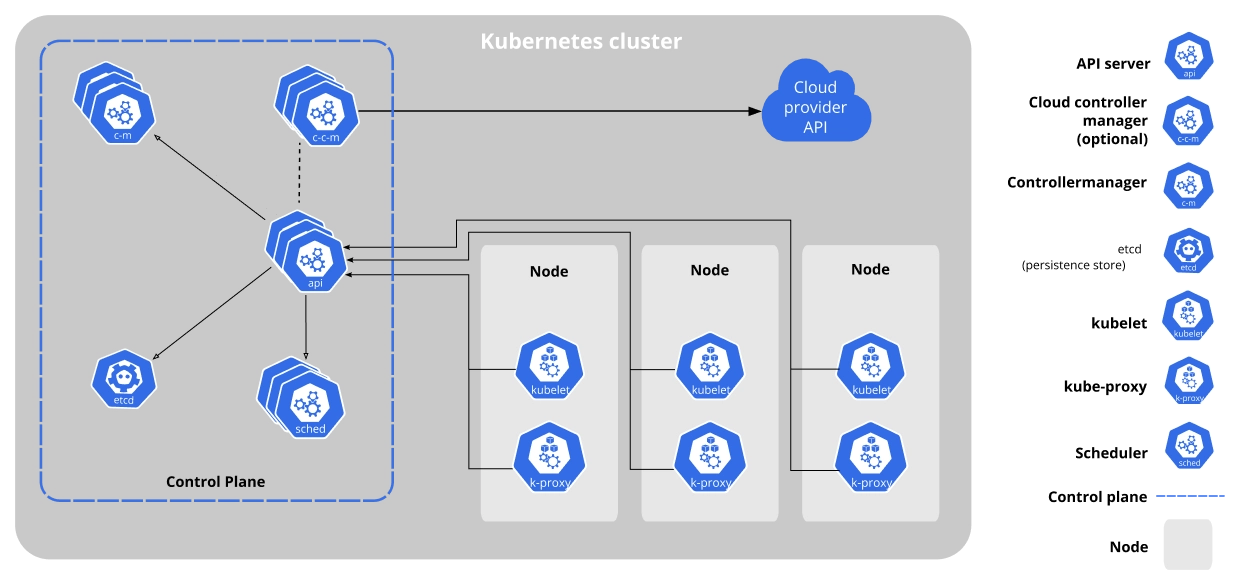
In this article, you’ll learn and understand what is a control plane in Kubernetes. You will understand its components, requirements, and other details. You’ll also learn how control planes work in virtual clusters. A fast-growing Kubernetes cluster virtualization technology.
The Kubernetes control plane is the brain behind a Kubernetes cluster. It manages the cluster's state, coordinates operations, and maintains health. Several Kubernetes components make up the control plane. These include:
The specifications for running a Kubernetes control plane vary. They depend on the cluster size, node count, and workload. Below are general guidelines for a small-scale (or development) environment:
Master node (control plane node):
etcd (cluster store):
These tips may suit learning, dev, or small cluster uses. In production or larger Kubernetes environments, you must scale up these resources. Do this based on the number of nodes, pods, and the workload's complexity.
The Kubernetes documentation does not set a hardware limit. It does provide guidelines for managing resources in large clusters. They are:
Make sure your cluster's config follows these guidelines. They ensure optimal resource use and performance when scaling up.
Ensuring the high availability of the Kubernetes control plane is essential. It maintains a robust and reliable container orchestration platform.
High availability minimizes downtime and ensures the continuous operation of critical Kubernetes control plane components. A highly available control plane contributes to the overall reliability of the cluster. This allows it to minimize the effects of hardware failure. It also reduces network issues and other unforeseen challenges.
The primary strategies for achieving high availability are replication and redundancy. Key control plane components should be replicated across multiple nodes to mitigate the impact of failures. This allows the cluster to continue functioning even if individual nodes or components experience issues.
Key strategies for high availability of your Kubernetes control plane include:
Kubernetes provides native features and tools to support high availability in the control plane:
In Kubernetes, "master node" and "control plane" often mean the same thing. They refer to the components that manage the cluster. However, "control plane" is a better, more accurate term. It has evolved from the "master node."
In the early days of Kubernetes, the term “master node” was commonly used to refer to a cluster node hosting the control plane components. The control plane components included the API server, controller manager, scheduler, and, in some cases, the etcd data store. The master node played a central role in managing the cluster’s state, receiving and processing API requests, and making decisions about resource allocation.
While the term “master node” accurately described the role of the node hosting the control plane components, it had some limitations and potential for misunderstanding:
As the understanding of Kubernetes architecture matured, the industry shifted towards using the term “control plane” to describe the collective set of components responsible for managing the cluster. This change in terminology reflects a more accurate and holistic view of the system. The control plane comprises all components that make decisions about the state of the cluster and ensure that the desired state is maintained.
The control plane includes, but is not limited to, the components traditionally hosted on a “master node.” This shift in terminology acknowledges the distributed and decentralized nature of Kubernetes, where multiple nodes can host control plane components for fault tolerance and scalability.
As discussed earlier, the key components of a control plane include the API server, the etcd data store, the controller manager, the scheduler, and an optional cloud controller manager.
The number of Kubernetes control planes you should have depends on factors such as your deployment goals, your desired level of availability, and the size and criticality of your workloads. The following are some considerations.
The single control plane setup is the most basic setup of all. A single control plane in Kubernetes refers to a deployment architecture where there is only one node responsible for hosting all the essential components of the control plane. This is straightforward to set up and manage, and it typically requires fewer resources than a setup with multiple masters.
Here are some of its use cases, advantages, and considerations:
A multiple control plane setup, on the other hand, refers to a deployment architecture where there are multiple control plane nodes, each hosting a full set of control plane components. This setup is designed to enhance the high availability and fault tolerance of the Kubernetes control plane.
In a multiple control plane configuration, if one control plane instance becomes unavailable or experiences issues, the remaining instances can continue to manage and control the cluster, ensuring continuous operation.
Here are some of its use cases, advantages, and considerations:
Such an architecture gives you the freedom to host and maintain dedicated control planes for various environments, cloud providers, and business units. If the nature of your business requires data or control to be segregated across regions or business teams, a multiple control plane approach can help you achieve compliance.
You can set up a multitenant environment easily with multiple control planes and allow teams to own their control planes and the associated resources.
Deploying a multiple control plane setup in Kubernetes brings numerous benefits in terms of availability and fault tolerance, but it also introduces additional complexity:
There are some ways to mitigate potential challenges with multiple control plane setups:
You could also consider a hybrid approach. Use a mixed single- and multiple-control plane setup. This would involve deploying clusters with different control plane configurations. Specific requirements and workloads would determine them. This hybrid approach lets organizations customize their Kubernetes setup. It helps them balance simplicity and high availability.
Some of the key characteristics of a hybrid approach include:
You can use any of the three approaches listed above according to your cluster’s requirements. These are some general guidelines that may also come in handy:
Everything covered so far assumes one control plane per physical cluster. But there's a growing pattern that decouples the two: provisioning a dedicated control plane per tenant on shared infrastructure. This is the model behind vCluster: each tenant — a team, a customer, or an AI workload — gets a real, certified Kubernetes control plane with its own API server, controller manager, and data store, provisioned in seconds rather than the minutes-to-hours a full cluster build takes.
Because each tenant has its own control plane, isolation problems that namespaces can't solve — cluster-scoped resources like CRDs, per-tenant API rate limiting, independent Kubernetes versions — disappear. And the infrastructure underneath is flexible: tenants requiring hard isolation boundaries can use Private Nodes — dedicated hardware attached exclusively to their control plane. This is the model AI cloud providers and large enterprises use to run GPU infrastructure at scale, where tenants need both strong isolation and fast provisioning.
The Kubernetes control plane is the key to orchestrating your cluster with precision. It’s the nerve center. It manages the state and ensures perfect workload performance. This guide covers the key components—API server, etcd, and controllers. It also explores new deployment strategies: single, multiple, and highly available control planes.
The next step for most platform teams isn't running one control plane well — it's running many. Whether you're isolating internal teams, serving external customers, or partitioning GPU infrastructure for AI workloads, vCluster gives every tenant a dedicated control plane on infrastructure you control, from shared nodes to fully private ones. Deploy your first tenant cluster in seconds.
Now it’s your turn to act! With vCluster, you can build strong, scalable, and resilient Kubernetes environments. Don’t wait—let vCluster guide you in taking control of your container orchestration future today.
The control plane in Kubernetes manages the cluster's state. It is a set of components. It keeps the desired state across the entire cluster as defined by users or apps.
The control plane handles key tasks. These include scheduling, deployment, scaling, and monitoring workload health. It is vital to maintain cluster functionality and ensure seamless operations. It does this by coordinating communication between nodes. It also manages resources to maximize efficiency.
The control plane has five key components. They include the API server, etcd, the controller manager, the scheduler, and the cloud controller manager. The API server is the entry point for all management commands. The etcd stores the cluster's state data.
The controller manager ensures the current state matches the desired state. It manages different controllers, like the node controller. The scheduler assigns workloads to the right nodes, based on resource availability. These components coordinate to ensure the cluster's desired state is consistently met.
The control plane contributes to high availability in Kubernetes. They do this by replicating key components across multiple nodes. These include the API server, etcd, and the controller manager. This redundancy lets the cluster work even if some nodes fail.
Kubernetes has built-in features. They include kube-apiserver replicas and highly available etcd clusters. They distribute requests and ensure fault tolerance. The control plane minimizes downtime and keeps production environments running. It does this by replicating its components and using load balancing.
Each tenant cluster runs its own fully independent control plane — API server, controller manager, and data store — separate from the host's control plane. This is the core of what makes isolation real rather than cosmetic: every tenant gets their own cluster-admin, RBAC policies, CRDs, and scheduler, so one tenant's configuration, identity, and namespaces are simply invisible to another. Isolation isn't imposed by convention or careful configuration, but as a structural property of the architecture.
Because each control plane is isolated but lean, running as pods rather than on physical clusters, you get the isolation model of separate clusters without the cost, footprint, or provisioning lag. Tenants can sprawl, break things, or run untrusted workloads, and the blast radius stays contained to their own environment. Nothing propagates to the host or to a neighboring tenant. For GPU cloud operators, this is what makes it safe to hand a customer full admin control over their slice of the infrastructure while keeping everyone else's out of reach.
Deploy your first virtual cluster today.
